
Spiritual Discernment: How to Find Clarity and Make Wise Choices

We may earn a commission for purchases made using our links. Please see our disclosure to learn more.
Have you ever felt strongly drawn toward a decision but struggled to explain why? Perhaps a relationship feels wrong despite appearing perfect on paper, or an opportunity seems exciting yet conflicts with what matters most to you. Spiritual discernment offers a way to examine those feelings without blindly following them.
Rather than promising a supernatural answer to every question, discernment encourages patient reflection on your motives, values, circumstances, and sense of purpose. Some people approach it through prayer and faith; others use quiet contemplation and personal ethics. Both can benefit from asking better questions and testing impressions against reality.
This guide explains how discernment works, how to distinguish guidance from fear, and which practical habits can help you make thoughtful decisions with greater confidence.
What Is Spiritual Discernment?
Spiritual discernment is the practice of carefully evaluating inner impressions, motivations, and possible choices in light of your deepest beliefs. It involves asking not merely, “What do I want?” but “What kind of person will this choice help me become?”
In Christian traditions, particularly Ignatian spirituality, discernment includes attending to movements of the heart to seek God’s guidance. Outside religion, it can mean aligning choices with compassion, integrity, and purpose. Neither makes intuition infallible.
Why Spiritual Discernment Matters in Daily Life
Most decisions are ordinary. They involve whether to speak honestly, accept another commitment, forgive someone, or protect your time. Small choices gradually shape relationships and habits.
Discernment creates space between a feeling and a response. You might realize that agreeing to help a friend comes from genuine generosity—or from fear of disappointing them. The distinction matters. The aim isn’t perfect certainty. It’s choosing more deliberately while staying open to learning from the outcome.
Spiritual Discernment vs. Intuition, Fear, and Impulse
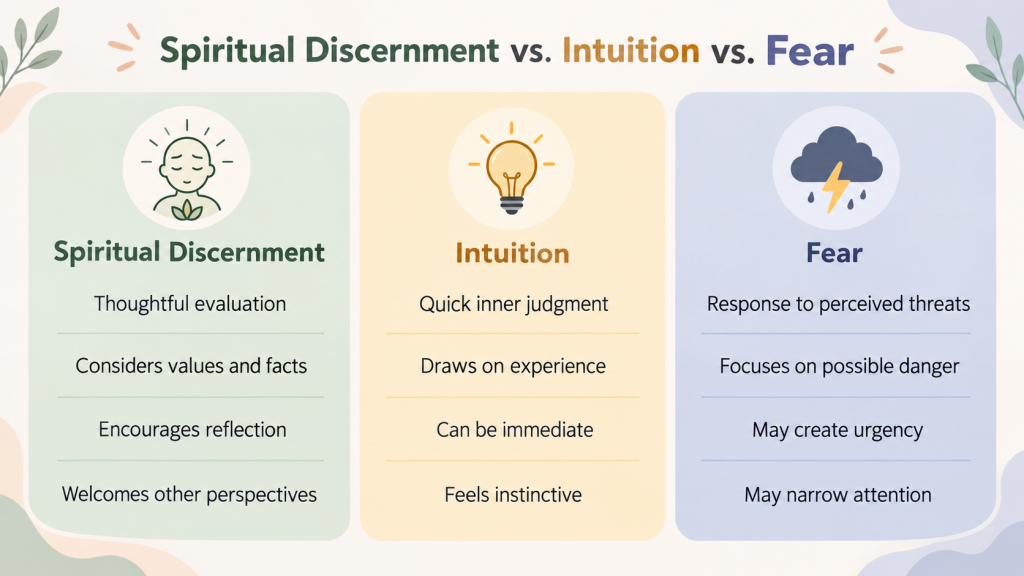
Intuition is a quick judgment that may draw on past experience. Discernment is the slower process of evaluating that judgment alongside evidence, values, and consequences. They can work together.
Fear deserves attention without automatically receiving control. Anxiety may reflect danger, unfamiliarity, or past hurt. Likewise, intense excitement can disguise wishful thinking.
Ask yourself: What facts support this feeling? What facts challenge it? Would I reach the same conclusion after a calm night’s sleep? These questions turn an impression into something you can assess.

Recognizing Guidance Without Expecting Certainty
Helpful guidance often points toward honesty, compassion, responsibility, and respect for other people’s freedom. Admitting a mistake, for example, can feel uncomfortable.
In Ignatian practice, spiritual consolation and desolation describe movements toward or away from faith, hope, and love; they are not simply happiness and sadness. The Office of Ignatian Spirituality’s discernment overview makes that distinction clear.
Judge an impression by its longer-term direction and consequences, not by how dramatic or peaceful it feels initially.
Begin With Your Values and a Clear Question
Vague questions produce vague answers. Replace “What should I do with my life?” with something specific, such as “Should I accept this role if it means less time with my family?”
Write down three values relevant to the decision, then identify any genuine conflict between them. Security and service, for example, may both matter deeply. Separate facts from imagined outcomes.
No option needs to be flawless. Look for a choice you can explain responsibly, including the sacrifices it requires and the people it affects.
Use Prayer, Silence, or Meditation to Create Space
Choose a practice that fits your beliefs. You might pray for wisdom, sit silently with a question, or spend several minutes noticing your breath before reflecting. None guarantees accurate spiritual messages.
Avoid using quiet time to chase a particular sensation. Instead, notice the thoughts that keep returning and whether they invite openness or narrow your attention.
If stillness increases distress, try walking or speaking aloud. Discernment should be adaptable, not another test you must pass.
Keep a Discernment Journal and Review Your Day
A journal reveals patterns beyond one emotional moment. Record the decision, what you felt, what happened, and what you learned. Revisit entries after several days.
A related Christian practice is the daily Examen: reviewing experiences with gratitude, noticing meaningful movements, and considering a wiser response tomorrow.
For more ways to explore inner listening, Soulglowz’s guide to spiritual guidance and your inner compass offers complementary reflection practices. Treat entries as observations, not predictions.
A Practical Step-by-Step Discernment Process
For an important choice, try this sequence:
- Name the decision. Define the options and your actual deadline.
- Gather facts. Check practical consequences, commitments, and missing information.
- Reflect quietly. Notice hopes, fears, values, and recurring motives.
- Seek perspective. Ask someone trustworthy to challenge your assumptions without deciding for you.
- Choose a proportionate step. Test an option when possible, or decide when enough information is available.
- Review the outcome. Notice what worked and adjust without blaming yourself for uncertainty.
Before changing careers, you might interview workers or try a course. Reflection becomes more useful when paired with evidence and a reversible first step.
Interpreting Signs, Dreams, and Coincidences Carefully
A repeating number, striking dream, or unexpected encounter may feel personally meaningful. It can prompt useful reflection, but it isn’t independent proof that an outside force wants you to make a particular choice.
We tend to notice confirming patterns. If a sign appears to confirm your preferred answer, actively consider another explanation and check the practical consequences.
Use symbols as prompts, never instructions overriding consent, safety, advice, or facts. A meaningful experience can matter to you without being a reliable prediction.
Applying Discernment to Relationships and Major Choices
Relationships require more than spiritual connection. Look for consistent respect, honesty, healthy boundaries, and behavior over time. Feeling intensely drawn to someone doesn’t excuse manipulation or mistreatment.
For major choices involving work, relocation, or finances, compare your spiritual priorities with realistic costs and responsibilities. Consult qualified professionals when specialized knowledge matters.
Two possibilities can both be worthwhile. Discernment then means accepting a trade-off instead of waiting for a sign that removes every risk. People affected by your choice deserve a voice, even when your conviction feels strong.
Common Discernment Mistakes and When to Seek Support
Avoid seeking confirmation until you hear your preferred answer. Another mistake is confusing pressure from a charismatic teacher with independent spiritual insight. Be wary of anyone who demands secrecy, obedience, money, or isolation as proof of your faith.
If fear makes you check signs compulsively, pause the practice and seek grounded support. A spiritual director, counselor, or trusted friend can clarify patterns while respecting your agency.
Serious distress, hearing commands, or feeling unsafe warrants professional healthcare support rather than treating those experiences as unquestionable spiritual instructions.
Helpful Books and Journals for Spiritual Discernment
Books and journals can structure reflection without making decisions for you.
The Discernment of Spirits: An Ignatian Guide for Everyday Living — Timothy M. Gallagher
Best for: Readers exploring traditional Ignatian discernment.
Gallagher explains the spiritual rules associated with Ignatius of Loyola and connects them to recognizable experiences of consolation and desolation. The book offers a structured Christian framework for interpreting inner movements rather than chasing dramatic signs. Its Catholic vocabulary may challenge newcomers.
The Way of Discernment: Spiritual Practices for Decision Making — Elizabeth Liebert
Best for: Readers seeking exercises for real-life decisions.
Liebert combines Christian reflections with practices intended to help readers identify where faith intersects with everyday choices. Exercises help when priorities feel equally important. It assumes a Christian understanding of guidance, so readers seeking a secular workbook may prefer a different approach.
Sacred Compass: The Way of Spiritual Discernment — J. Brent Bill
Best for: Readers drawn to quiet, contemplative spirituality.
Drawing from Quaker practice, Bill presents discernment as attentiveness to God’s presence, not simply a technique for selecting the correct outcome. Its reflective tone favors listening over checklists. People who need a highly detailed decision worksheet may find its approach less procedural.
The Gift of Being Yourself: The Sacred Call to Self-Discovery — David G. Benner
Best for: Readers examining identity and underlying motives.
Benner explores how Christian self-understanding and awareness of one’s authentic identity inform spiritual growth. The expanded edition includes reflection questions useful for examining approval-seeking, expectations, and personal motives. It’s especially relevant before a decision shaped by other people’s opinions, though it is not a dedicated step-by-step decision manual.
Intelligent Change The Five Minute Journal — Original Daily Gratitude Journal
Best for: Beginners who want a short daily writing routine.
This undated, guided journal offers morning and evening prompts for gratitude, intentions, and daily reflection, with room for approximately six months of entries. Its format helps reluctant journalers. Because it emphasizes gratitude rather than difficult decisions, you’ll need to add your own discernment questions.
What Research Reveals About Reflection and Decision Making
Scientific studies can investigate attention and decision-making, but they cannot establish whether a feeling comes from divine guidance. Research therefore supports particular reflective habits, not supernatural certainty.
In a 2021 experimental study of brief mindfulness and uncertain decisions, researchers studied 398 participants. A short mindfulness exercise was associated with quicker, more approach-oriented choices overall, but participants inclined to maximize outcomes showed the opposite pattern. The effects depended on the person and task.
A 2026 preregistered study of mindfulness and metacognition found no evidence that 31 days of mindfulness training improved the measured ability to judge one’s own value-based decisions relative to control training.
These findings favor modest expectations: use reflection as a pause, then check decisions against evidence and feedback.
Frequently Asked Questions About Spiritual Discernment
How do I start practicing spiritual discernment?
Start with one specific, manageable decision and write down why it matters to you. Spend a few minutes in prayer or quiet reflection, then compare your impressions with the facts and your values. Seek perspective if needed. Reviewing the decision afterward builds a more grounded practice than expecting immediate certainty.
How can I distinguish God’s guidance from my own thoughts?
There is no universally reliable test that proves an inner thought comes from God. Within a Christian framework, evaluate the thought against your faith’s teachings, its effects on love and responsibility, and wise counsel. Allow time for reflection, especially if the idea urges secrecy, cruelty, or rash action. Remain open to correction.
Does spiritual discernment require a religious belief?
No, although the meaning differs across traditions. Christians may understand discernment as seeking God’s will; someone without religious commitments may use the term for ethically examining intuition, motives, and life direction. In either case, humility and attention to practical evidence matter. You can adopt reflective habits without claiming that every experience carries a supernatural message.
Can spiritual discernment help with relationships?
Yes, it can help clarify your motivations and boundaries, provided you also assess the other person’s behavior. Ask whether the relationship supports mutual respect and honest communication. Don’t treat a dream, strong attraction, or advisor’s prediction as permission to ignore warning signs. When safety is in question, prioritize practical support and protection.
What if I still feel uncertain after reflecting?
Uncertainty does not automatically mean you’ve discerned incorrectly. Some decisions involve incomplete information or two genuinely good options. Set a reasonable deadline, gather what you can, and choose a responsible next step. If possible, make a reversible commitment first. Reassess as new information appears instead of repeating rituals until doubt disappears.
Final Thoughts on Spiritual Discernment
Spiritual discernment works best as a thoughtful practice, not a hunt for perfect signs. Begin with a clear question, make room for silence, consider your values, and check your impressions against relationships, evidence, and consequences. A trusted conversation or a small practical experiment can reveal more than endless speculation.
For Christian readers, Gallagher’s The Discernment of Spirits provides a detailed starting framework. If you’re building a reflection habit, The Five Minute Journal offers accessible daily prompts, though you’ll need to bring your own decision questions.
Remember that clarity sometimes arrives only after you take an informed step. Choose the most responsible option available, respect other people’s autonomy, and remain willing to learn from what follows.