
How To Create a Personal Manifestation Statement

We may earn a commission for purchases made using our links. Please see our disclosure to learn more.
Have you ever felt certain that you wanted something more from life but struggled to put that desire into words? Perhaps you want greater financial stability, healthier relationships, a more fulfilling career, or simply a stronger sense of inner peace.
A personal manifestation statement gives those desires direction. Instead of leaving your aspirations as passing thoughts, it helps you express what you want to experience, who you want to become, and how you intend to move forward.
You don’t need elaborate rituals or perfectly chosen words to get started. The most meaningful statements reflect your values, acknowledge your circumstances, and encourage purposeful action.
This guide explains how to write your own statement, choose meaningful language, avoid common mistakes, and incorporate manifestation into your spiritual practice without losing sight of reality.
What Is a Manifestation Statement?
A manifestation statement is a personal declaration that expresses an intention, desired experience, or meaningful life goal. It puts your aspirations into words that you can revisit through journaling, meditation, or quiet reflection.
For example, someone seeking greater confidence might write:
“I am learning to trust my abilities, express myself honestly, and welcome opportunities that support my growth.”
Within spiritual practices, these statements can represent an intention to align your thoughts, beliefs, and actions with your desired direction.
They are not guarantees that specific events will happen. Think of them as reminders of what matters to you and how you want to approach life.
Manifestation Statements vs. Positive Affirmations
Manifestation statements and positive affirmations often overlap, but they can serve slightly different purposes.
| Aspect | Manifestation Statement | Positive Affirmation |
| Main purpose | Express a desired direction | Reinforce a supportive belief |
| Focus | Future experiences and growth | Self-perception and mindset |
| Example | I am building a fulfilling career. | I am capable and resourceful. |
| Application | Intention setting and planning | Daily encouragement |
Neither approach is inherently better. An affirmation can support the confidence needed to pursue an intention, while a manifestation declaration gives that confidence a meaningful direction.
You can also combine both approaches within a single statement.

Identify What You Truly Want to Manifest
Before choosing your words, spend time understanding the desire behind them. Sometimes, what you initially want represents a deeper emotional or spiritual need.
For instance, wanting a higher income might reflect a desire for independence, security, or more time with loved ones.
Ask yourself:
- What area of my life needs greater attention?
- Why does this desire matter to me?
- How would achieving it change my everyday life?
- Does this intention reflect my values or someone else’s expectations?
Write your responses down without criticizing or evaluating them. Identifying the underlying motivation makes it easier to create a statement that feels personally meaningful rather than borrowed from someone else’s vision of success.
Choose a Clear and Realistic Intention
A statement becomes more useful when it expresses a recognizable direction. Broad declarations such as “I attract everything I desire” may sound uplifting, but they offer little practical guidance.
Compare these examples:
- Broad intention: I want a better life.
- Clear intention: I am creating a balanced life through meaningful work, healthier boundaries, and responsible financial decisions.
Clarity doesn’t mean controlling every detail of your future. Leave room for unexpected opportunities and changing circumstances.
Focus primarily on experiences and decisions you can influence rather than outcomes that depend entirely on other people.
Use Present-Tense and Positive Language
Many manifestation practices encourage present-tense wording because it emphasizes the qualities and behaviors you want to cultivate now.
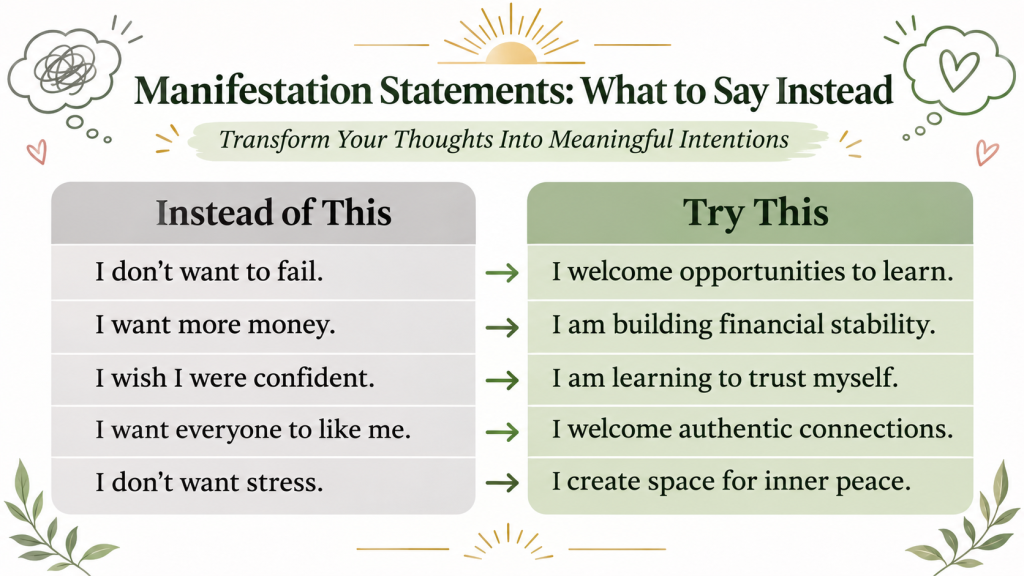
Instead of writing, “I will stop doubting myself,” consider, “I am developing greater trust in my abilities.”
Your statement should also feel believable. Declaring that you are wealthy when you are struggling financially may create discomfort rather than encouragement.
Gentler alternatives include:
- I am learning to…
- I am working toward…
- I welcome opportunities to…
- I choose to…
- I am becoming more…
Positive wording should guide your attention toward growth without requiring you to deny genuine difficulties or uncomfortable emotions.
Follow a Simple Manifestation Statement Formula
You can create a personalized declaration using four basic elements: intention, meaning, personal commitment, and openness.
Use this fill-in-the-blank template:
I am creating [desired experience] because I value [personal meaning]. I support this intention by [practical action], while remaining open to [growth or possibilities].
For example:
“I am creating greater financial stability because I value independence and security. I support this intention by managing my spending, developing useful skills, and welcoming realistic opportunities to increase my income.”
You can shorten the formula once your intention becomes clear. A memorable sentence that genuinely resonates with you is often more practical than an elaborate declaration.

Manifestation Statement Examples for Different Goals
Use these examples as starting points and adapt them to your circumstances.
| Life area | Example statement |
| Career | I am developing my skills and pursuing meaningful professional opportunities. |
| Financial abundance | I am building financial security through thoughtful decisions and consistent effort. |
| Relationships | I welcome relationships built on mutual respect, honesty, and understanding. |
| Self-love | I treat myself with kindness while allowing room for personal growth. |
| Spiritual growth | I welcome greater awareness, inner balance, and connection to my values. |
| Confidence | I trust myself to learn, make decisions, and navigate uncertainty. |
| Inner peace | I create space for rest, reflection, and emotional balance. |
Choose language that reflects your actual needs rather than selecting whichever example sounds the most impressive.
Connect Your Words With Meaningful Emotions
Your declaration should remind you why your intention matters. If you are seeking a fulfilling career, imagine what meaningful work could bring to your daily routine.
Consider feelings such as freedom, satisfaction, connection, or stability. Notice which ones resonate most strongly.
You don’t need to experience excitement every time you repeat your statement. Some days, hope may feel distant, and that is a normal part of navigating uncertainty.
Allow your spiritual practice to accommodate difficult emotions instead of treating sadness, doubt, or frustration as obstacles that automatically prevent positive outcomes.
Create a Daily Manifestation Routine
A consistent routine gives you an opportunity to reconnect with your intentions before everyday responsibilities take over.
Try this simple five-minute practice:
- Find a quiet place where you can reflect.
- Take a few slow, comfortable breaths.
- Read your statement aloud or silently.
- Consider one action that supports your intention.
- Write down that action and follow through when possible.
You can practice in the morning, before bedtime, or during a meditation session. Choose a time that fits naturally into your schedule rather than creating another demanding obligation.
Turn Your Intentions Into Practical Actions
Manifestation becomes more grounded when your intentions influence your everyday behavior. Consider what you can realistically do to move closer to your desired outcome.
For example, if you are manifesting professional growth, your actions might include updating your résumé, developing a new skill, or contacting a potential employer.
Prepare for predictable challenges using an if-then plan:
“If I feel intimidated by a job application, then I will spend ten minutes working on it.”
This approach gives you something constructive to do when uncertainty or hesitation arises.
Common Manifestation Mistakes to Avoid
Manifestation should support personal growth rather than become a source of pressure or disappointment.
Avoid these common mistakes:
- Expecting immediate results without taking action.
- Copying statements that don’t reflect your values.
- Attempting to control another person’s choices.
- Ignoring financial, emotional, or practical limitations.
- Blaming yourself when circumstances don’t improve.
- Treating negative emotions as personal failures.
Revisit your intentions periodically. If your priorities change, give yourself permission to adjust your statement.
A personal spiritual practice should accommodate the realities of your life, including experiences you cannot predict or control.
Recommended Products for Your Manifestation Practice
These optional tools can help you organize your thoughts, establish consistent routines, and translate your intentions into everyday actions.
Intelligent Change The Five Minute Journal
Best for: Beginners who prefer guided journaling.
This journal provides structured daily prompts centered on gratitude, reflection, and personal growth. You can incorporate your manifestation declaration into your morning writing routine and reflect on your progress later. Its guided format reduces uncertainty about what to write, although people who prefer unrestricted journaling may find the structure limiting.
Pilot G2 Premium Gel Roller Pen, 0.7 mm
Best for: Handwritten intentions and daily journaling.
The Pilot G2 features gel ink and a 0.7 mm writing tip, making it suitable for recording intentions, reflections, and personal observations. Keeping a dedicated pen beside your journal makes starting your practice more convenient. Allow the ink to dry before closing your journal, particularly when writing on smoother paper.
Post-it Super Sticky Notes, 3 x 3 Inches
Best for: Visible daily reminders.
These compact adhesive notes provide an uncomplicated way to display short intentions near your workspace, mirror, or journal. Their repositionable design allows you to change your reminders as your priorities evolve. They work particularly well for concise declarations, although longer statements may require a notebook or larger writing surface.
Time Timer MOD 60-Minute Visual Timer
Best for: Establishing distraction-free reflection sessions.
This desktop timer displays remaining time through a gradually disappearing colored disk. Set aside five or ten minutes for visualization, journaling, or quiet reflection without repeatedly checking your phone. Its visual countdown supports structured sessions, although a dedicated timer may be unnecessary if your existing routine already works well.
Rethinking Positive Thinking: Inside the New Science of Motivation by Gabriele Oettingen
Best for: Combining manifestation with realistic goal setting.
Written by a psychology researcher, this book explores the limitations of positive fantasies and introduces practical methods for identifying obstacles and planning responses. It complements manifestation by encouraging readers to connect aspirations with behavior. Its approach is psychological rather than spiritual, making it particularly useful for balancing both perspectives.
The Science Behind Affirmations and Intention Setting
Psychological research offers useful insights into practices commonly associated with manifestation, although it does not establish that thoughts alone can attract external events.
A 2014 review of self-affirmation research by Geoffrey Cohen and David Sherman examined how reflecting on important personal values can help people respond more constructively to psychological threats. These interventions differ from simply repeating positive declarations.
Additionally, a 2021 meta-analysis published in Frontiers in Psychology found that combining mental contrasting with implementation intentions had a small-to-moderate positive effect on goal attainment.
Mental contrasting involves imagining a desired future while acknowledging obstacles. Implementation intentions involve planning specific responses to those challenges.
Together, these findings suggest that connecting meaningful aspirations with realistic planning may be more useful than relying exclusively on positive thinking.
Frequently Asked Questions About Manifestation Statements
How long should a manifestation statement be?
One to three sentences is a practical starting point for most people. Your statement should be detailed enough to communicate a meaningful intention but short enough to remember comfortably. Longer declarations can work well during journaling, while shorter versions are convenient for meditation and everyday reminders.
How often should I repeat my manifestation statement?
You can repeat your statement daily or whenever you need to reconnect with your intention. There is no scientifically established repetition frequency that guarantees results. Focus on meaningful reflection and consistent behavior rather than counting repetitions or worrying about missing a day.
Is it possible to manifest several goals at once?
Yes, you can maintain intentions for several areas of your life. However, focusing on one or two priorities may make it easier to direct your attention and resources effectively. Consider keeping separate statements for financial stability, relationships, career development, and spiritual growth.
Do manifestation statements have to start with “I am”?
No. Although “I am” is popular in manifestation practices, it is not a requirement. Expressions such as “I welcome,” “I choose,” and “I am working toward” can be equally meaningful. Select wording that feels authentic, encouraging, and appropriate for your present circumstances.
Can I write my manifestation statement on my phone?
Yes, a digital notes application works just as well for recording and revisiting your intentions. You can also save your statement as a private reminder or wallpaper. Handwriting is a personal preference, not a necessary condition for a meaningful manifestation practice.
Conclusion
Creating a personal manifestation statement begins with understanding what genuinely matters to you. Your words should reflect your values, communicate a clear intention, and encourage decisions that support your desired direction.
Keep your practice manageable. The Five Minute Journal can provide structure if you enjoy guided reflection, while simple sticky notes can help keep your intentions visible throughout the day.
Developing spiritual discernment can also help you evaluate whether your desires align with your deeper values.
Remember that manifestation is a personal spiritual practice, not a guarantee of particular outcomes. Start with one meaningful intention, express it in language you believe, and identify a realistic action you can take to support it.