The Many Benefits Of Kemetic Spirituality

We may earn a commission for purchases made using our links. Please see our disclosure to learn more.
If you’ve ever felt spiritually “homeless” — like your heart wants something ancient, grounded, and real, but modern life keeps yelling emails! errands! doomscrolling! — Kemetic Spirituality can feel like a deep exhale.
It’s a path inspired by the spiritual traditions of ancient Kemet (ancient Egypt), centered on living with balance, honoring the Divine, and shaping your character in a way that actually shows up in your daily life (not just on your bookshelf).
In this guide, you’ll learn what Kemetic Spirituality is, how it works in modern life, and simple practices you can try without needing to be “perfect.” You’ll also get supportive tools, research-backed context, and answers to common questions.
Affiliate note: This article mentions Amazon products. If you choose to purchase, you may support the site at no extra cost to you.
What Is Kemetic Spirituality?
Kemetic Spirituality (sometimes called Kemetism or modern Kemetic religion) is a contemporary spiritual path inspired by the religious and ethical traditions of ancient Egypt.
At its core, it’s about three things:
- Living in balance (not chasing constant intensity)
- Building character through right action
- Connecting with the Divine through the Netjeru (Egyptian deities), ancestors, and sacred ritual
Think of it like learning a “spiritual language” that’s thousands of years old — and then speaking it with your modern voice.
A quick clarification that matters
Kemetic Spirituality isn’t one single organization. Some people practice through formal groups (like Kemetic Orthodoxy). Others practice solo, in a personal and respectful way. Both can be valid, depending on your goals and your level of study.
Why Kemetic Spirituality Feels So Healing Right Now
A lot of people come to this path after feeling burned by one of two extremes:
- Spiritual chaos (trying everything, feeling nothing)
- Spiritual pressure (rules without heart, shame without growth)
Kemetic Spirituality tends to offer a third option: structure with warmth.
It gives you a steady container — like a bowl that holds your practice — so your life doesn’t have to be perfect for your spirit to be nourished.
The “nervous system” benefit
Even simple rituals (lighting a candle, saying a short prayer, offering water) can create a sense of safety and rhythm. Your brain likes rhythm. Your heart likes meaning. Kemetic practice quietly feeds both.

The Heart of the Path: Ma’at
If Kemetic Spirituality had a “north star,” it would be Ma’at.
Ma’at is the principle of truth, justice, balance, harmony, and right order. It’s also personified as a goddess — but even when people speak of Ma’at as a deity, they’re usually pointing to the practice of living rightly, not just “believing the right thing.”
What Ma’at looks like in real life
Ma’at can be…
- telling the truth without being cruel
- keeping your word (or clearly renegotiating it)
- cleaning up your side of the street
- making peace with the fact that rest is not laziness
And yes, Ma’at can also mean boundaries. Balance doesn’t happen when you let everyone borrow your energy with no return.
Meeting the Netjeru Without Feeling Intimidated
Netjeru (singular: Netjer) is a common Kemetic term for the divine forces/deities of ancient Egypt — like Ausar (Osiris), Aset (Isis), Heru (Horus), Anpu (Anubis), Djehuty (Thoth), Sekhmet, Hathor, and many more.
If the word “deities” makes you nervous, try this framing:
The Netjeru can be approached as personalities, principles, powers, and archetypes — different faces of the sacred.
“What if I pick the wrong one?”
You’re not marrying a deity. You’re introducing yourself.
Start with curiosity. Approach respectfully. Keep it simple. Over time, you’ll feel what resonates.
Your Spiritual “Energy Anatomy”: Ka, Ba, and Akh
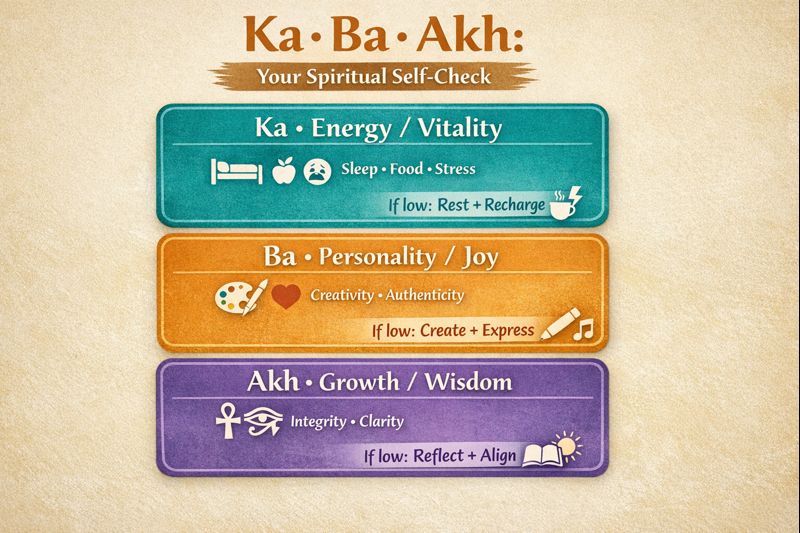
Ancient Egyptian spirituality included a layered view of the self. Modern Kemetic practitioners often reference:
- Ka: life-force / vitality (what fuels you)
- Ba: personality / unique essence (your “you-ness”)
- Akh: the transformed, shining self (often linked to spiritual maturity)
You can use this as a practical check-in:
- Is my Ka depleted? (sleep, food, stress, overstimulation)
- Is my Ba being honored? (creativity, authenticity, joy)
- Am I growing into my Akh? (wisdom, integrity, inner clarity)
It’s like spiritual self-care… with an ancient blueprint.
Simple Daily Practices You Can Actually Keep Up With
You don’t need a three-hour ritual. You need something you’ll do again tomorrow.
Here are gentle, doable ideas:
A 2-minute morning offering
- Pour a glass of cool water.
- Speak a short intention: “May I live in Ma’at today.”
- Place the water on your altar or a clean spot with respect.
A “Ma’at moment” at midday
Ask yourself:
- “What would balance look like in the next hour?”
Then do the smallest version of it.
A nightly reset
- Name one thing you did well.
- Name one thing you’ll do differently.
No drama. Just honesty.
Altars, Offerings, and Ritual—What Actually Matters
An altar isn’t a museum exhibit. It’s a relationship space.
Yes, you can have statues, candles, incense, beautiful bowls… but the heart of ritual is presence.
Basic altar items (start small)
- a candle (or LED candle)
- a cup/bowl for water offerings
- a small image or symbol that represents your practice
- a clean cloth or surface
Offerings that are simple and traditional-feeling
- water
- bread
- fruit
- flowers
- incense (if it works for your home and health)
Pro tip: If incense triggers headaches, skip it. The gods don’t want you suffering for aesthetics.
Prayer and Heka: The Power of Spoken Words
In many Kemetic-inspired practices, words matter. A lot.
You’ll sometimes see the word heka, often described as sacred power expressed through intention, speech, and ritual action. In plain language: what you repeatedly say and do shapes your inner world — and often your outer choices too.
Try this “spoken Ma’at” practice
Say (out loud if you can):
- “I choose truth.”
- “I choose balance.”
- “I choose right action — even in small ways.”
It sounds simple because it is. And that’s the point.
Ancestors, Community, and Belonging
Kemetic Spirituality often includes ancestor veneration — not as spooky vibes, but as grounded remembrance.
Your ancestors can include:
- blood ancestors
- cultural ancestors
- spiritual ancestors (teachers, elders, beloved dead)
A gentle ancestor practice
Place a cup of water. Say:
“May my ancestors who wish me well be near. May I live in a way that honors what they endured.”
And if your family line is complicated? You’re allowed to set boundaries in ancestor work too. Honor doesn’t mean romanticizing harm.
Shadow Work, Healing, and Emotional Honesty
Kemetic practice can be tender and strong at the same time.
Because Ma’at asks for truth, people often find that this path supports:
- self-respect
- emotional regulation
- clearer boundaries
- healthier choices
Not magically. Not overnight. But steadily.
A reflective question that hits (in a good way)
Where am I asking for balance from others… while refusing to practice it myself?
That’s not shame. That’s growth.
Kemetic Spirituality in Modern Life
Here’s the part I love: you don’t need to move to a desert temple.
Kemetic Spirituality can live inside modern routines:
- At work: practice Ma’at through honesty, fairness, and clean boundaries
- In relationships: speak truth with compassion, not performance
- With money: make choices that reduce chaos (even small ones)
- With your body: treat health like sacred stewardship, not punishment
And when you mess up? You return. You reset. You try again. That’s also Ma’at.
Product Section: Tools That Support Kemetic Practice
1) The Complete Gods and Goddesses of Ancient Egypt (Richard H. Wilkinson)
A clear, approachable reference that helps you understand the Netjeru beyond surface-level stereotypes.
Features
- profiles of major Egyptian deities
- helpful context for symbolism and roles
- easy to dip into when you’re learning
Best for
- beginners who want structure
- anyone building respectful deity relationships
2) The Egyptian Book of the Dead: The Book of Going Forth by Day (translation/edition varies)
A classic text for understanding afterlife symbolism, ethics, and devotional imagination in ancient Egypt.
Features
- foundational mythic and ritual themes
- rich symbolism (great for journaling prompts)
- deepens your historical connection
Best for
- spiritual readers who love sacred texts
- practitioners who want tradition-flavored inspiration
3) The Ancient Egyptian Prayerbook (Tamara L. Siuda)
A practical collection that supports daily prayer, praise, and devotional rhythm.
Features
- ready-to-use prayers (no “what do I say?” panic)
- devotional structure without rigidity
- great for consistent practice
Best for
- anyone who wants prayers they can actually use
- people building a daily Kemetic routine
4) The Kemetic Daily Devotional (Tamara L. Siuda)
A day-by-day style support tool — helpful when you want momentum without overthinking.
Features
- daily devotional format
- encourages consistency and reflection
- pairs well with journaling
Best for
- busy people
- anyone who wants “open and go” guidance
5) Plant Guru Frankincense & Myrrh Exotic Incense Sticks (bulk bundle)
A simple sensory support for ritual, prayer, and sacred-space cues — especially if scent helps you shift gears.
Features
- classic resin-inspired scent profile
- great “ritual anchor” (your brain learns the cue)
- bulk quantity for regular practice
Best for
- people who love incense as a ritual signal
- altar time, prayer time, meditation time
Bonus (for symbolic tools lovers): If you also explore divination as a reflection practice, you might enjoy this quick guide to types of tarot cards (it helps you understand the structure before you start pulling meanings).
Research-Backed Confidence: What Scholarship Suggests
Kemetic Spirituality is a living, modern practice — and at the same time, it draws from concepts scholars study seriously: ethics, ritual, meaning-making, and contemplative practice.
1) Ma’at as ethics (not just a “cool idea”)
A peer-reviewed legal-history analysis discusses ma’at as a foundational concept tied to morality, ethics, and social order in ancient Egypt — essentially, the principle that helped keep chaos at bay through right action. See: ma’at and ancient Egyptian order.
Why this matters for Kemetic Spirituality: your practice isn’t only “ritual.” It’s character. It’s how you live.
2) Meditation-style practices and stress relief (what the evidence says)
A large systematic review and meta-analysis in JAMA Internal Medicine (2014) examined meditation programs and found moderate evidence for improvements in anxiety and depression, based on 47 trials (3,320 participants), with small-to-moderate effect sizes. See: meditation programs and psychological stress (2014).
Why this matters for Kemetic Spirituality: when you include steady prayer, breathwork, or contemplative quiet in your Kemetic routine, you’re not just being “spiritual.” You’re also training your mind and nervous system.
Is Kemetic Spirituality a religion or a personal spirituality practice?
Both, depending on how you approach it.
Some people practice Kemetic Spirituality as a full religion with formal ritual structure and community. Others practice it as a personal spiritual path inspired by ancient Egyptian spirituality, focusing on Ma’at, devotion, and ethical living. Your sincerity and consistency matter more than labels.
How do I start Kemetic Spirituality if I don’t know any Egyptian prayers?
Start with simple, honest words.
Try: “May I live in Ma’at today. May I act with truth and balance.” Offer a glass of water. Light a candle. Sit quietly for two minutes. Consistency beats complexity — especially at the beginning.
FAQs
Can I practice Kemetic Spirituality and still be Christian, Muslim, or spiritual-but-not-religious?
Many people blend practices, but you’ll want to do it thoughtfully.
Kemetic Spirituality includes devotional relationships with Netjeru, so it may conflict with some religious boundaries. If that’s you, you can still learn from Ma’at as an ethical practice (truth, justice, balance) and keep your approach aligned with your beliefs.
What are the benefits of Kemetic Spirituality for mental health and stress?
People often report benefits like:
- more calm (because ritual creates rhythm)
- better boundaries (because Ma’at values balance)
- stronger self-trust (because you practice truth)
Kemetic Spirituality isn’t a replacement for therapy or medical care, but it can become a supportive framework that helps you make steadier choices — and feel less spiritually scattered.
How do I know which Netjeru I should work with?
Start with study + observation.
Read about the Netjeru that naturally pull your attention. Notice what themes keep showing up in your life (healing, courage, learning, protection, joy). Then begin with respectful introductions: a short prayer, a water offering, a journal entry asking for clarity.
And here’s the comforting part: if it’s not a fit, you can adjust. This is a relationship, not a test.
Closing Thoughts
Kemetic Spirituality can be a powerful reminder that you don’t have to hustle your way into wholeness. You can build a life that feels steadier — one small act of Ma’at at a time.
So pick one practice from this article. Just one. Try it for a week.
Let it be imperfect. Let it be real. That’s how a spiritual path becomes a home.