
Tarot Oracle: What It Is and How It Works
We may earn a commission for purchases made using our links. Please see our disclosure to learn more.
Ever pull a card (or three), stare at the artwork, and think… “Okay, what are you trying to tell me?” If you’ve been curious about tarot oracle but worried it’s either too mystical or too complicated, you’re in the right place.
Think of tarot + oracle cards like a mirror and a flashlight. Tarot shows you the shape of the situation (the mirror). Oracle adds a helpful beam of guidance (the flashlight). Put them together, and you get a practice that can feel grounding, clarifying, and honestly kind of comforting—especially when your brain won’t stop spinning.
What “Tarot Oracle” Actually Means
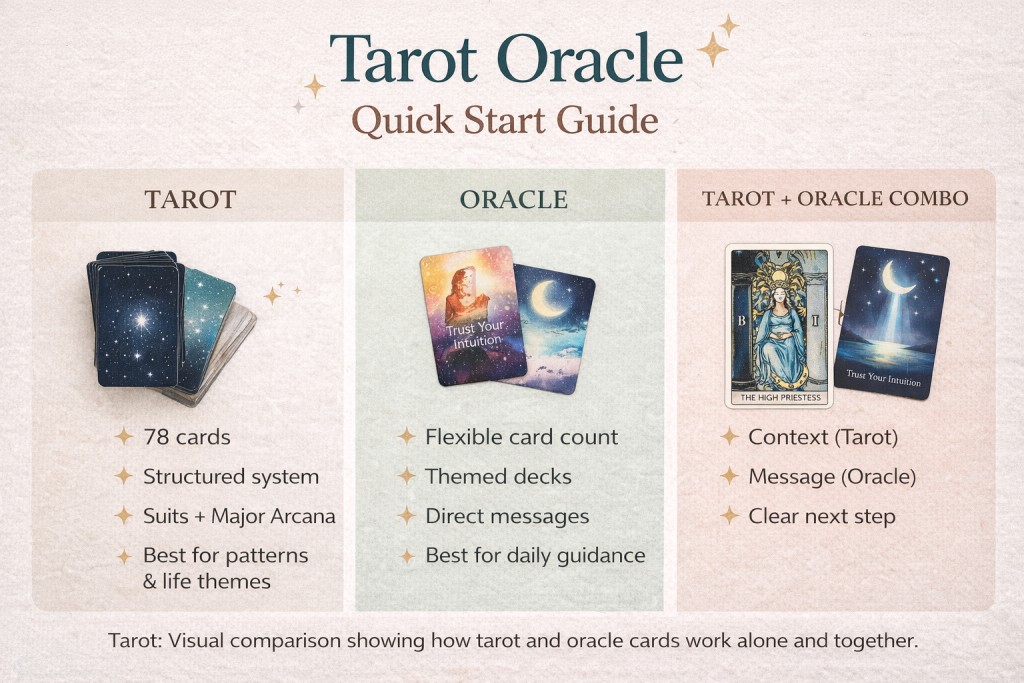
“Tarot oracle” usually refers to using tarot cards and oracle cards together in one reading—or learning both styles as a combined practice.
- Tarot = a structured system (78 cards, shared archetypes, classic suits)
- Oracle = a flexible system (varies by deck theme, number of cards, and style)
If tarot is like learning a musical scale, oracle is like improvising over a vibe. You can do either one alone… but together? That’s where it gets fun.
Tarot vs Oracle Cards: The Real Difference
Let’s make it simple:
Tarot cards (the “story framework”)
Tarot tends to answer: What’s happening? Why? What’s the pattern? What’s the lesson?
It’s great for seeing the moving parts—your role, their role, the obstacle, the opportunity.
Oracle cards (the “message and mood”)
Oracle tends to answer: What do I need to hear right now? What energy should I embody? What’s the next gentle step?
It often feels more direct, like a supportive voice note from your wiser self.
Neither is “better.” They’re just different tools for different moments.
What Tarot Oracle Can Help You With
Tarot oracle shines when you want clarity and self-trust, not a rigid prediction.
It can help you:
- untangle mixed feelings (“Why am I so stuck on this?”)
- choose a direction (“What happens if I say yes vs no?”)
- spot patterns (“Why do I keep repeating this cycle?”)
- calm anxious spirals (“What can I control today?”)
What it’s not great for:
- guaranteed timelines (“exactly when will they text me?”)
- replacing medical, legal, or financial advice
- making choices for you when you already know the answer but don’t want to admit it (we’ve all been there)
How Tarot Oracle Works
A tarot oracle reading usually works because of three ingredients:
Symbol (your brain loves meaning)
Your mind is wired to notice patterns. Images, archetypes, and metaphors can unlock insights that plain logic can’t reach.
Story (context changes everything)
The same card can mean something different depending on the question and the surrounding cards. You’re not “memorizing meanings.” You’re reading a story.
Intuition (your inner knowing gets a microphone)
Intuition isn’t magic. It’s often your experience, values, and gut sense speaking up—especially when you finally get quiet enough to listen.
Choosing a Tarot Oracle Deck That Fits You
Here’s the best advice: pick the deck you actually want to use.
A few quick guidelines:
Choose artwork you understand
If you look at a card and feel nothing but confusion, you’ll avoid the deck. If the imagery makes you feel something—curious, comforted, challenged—that’s a good sign.
Start with “readable” decks
Beginner-friendly decks often have clear expressions, everyday scenes, and guidebooks written in plain language.
Let your lifestyle decide
- Busy life? Pick a deck with short meanings and simple spreads.
- Deep reflective type? Pick a deck that leans into shadow work and journaling prompts.
- Easily overwhelmed? Choose a gentle oracle deck for emotional support.
Getting to Know Your Deck
You don’t need a full moon, incense, or a velvet cloak (unless you want one—no judgment).
Try this instead:
A simple “deck hello” ritual
- Hold the deck and breathe slowly for 10 seconds.
- Ask: “What are you here to help me with?”
- Pull one card and write 2–3 sentences about how it feels.
Basic care that actually matters
- Store your deck where it won’t get bent or sticky
- Keep liquids away (coffee + cards = tragedy)
- If you share your deck, set a boundary: “Clean hands only” is totally reasonable
The Best Questions to Ask in Tarot Oracle
The quality of your reading depends on the quality of your question.
Great tarot oracle questions:
- “What do I need to understand about this situation?”
- “What’s my blind spot here?”
- “What’s a supportive next step?”
- “How can I communicate more clearly?”
- “What’s the energy of this connection right now?”
Questions that get mushy answers:
- “Will it work out?” (too vague)
- “What will happen?” (too broad)
A tiny upgrade that changes everything: add “right now” or “next step.”
Example: “What’s the next step I can take right now to feel more stable?”
3 Beginner Tarot Oracle Spreads You’ll Actually Use
1) The “Clear My Head” 3-card spread
- Card 1: What’s really going on?
- Card 2: What I’m not seeing
- Card 3: My next best step
2) The “Choice” spread
- Card 1: If I choose option A…
- Card 2: If I choose option B…
- Card 3: What I need to decide well
3) Tarot + Oracle combo
- Tarot card: The situation / pattern
- Tarot card: The challenge
- Oracle card: The message I need most
This combo is chef’s kiss when you want both structure and reassurance.
How to Interpret Card Meanings Without Overthinking
Here’s the secret: read the picture first.
Before you grab the guidebook, ask:
- What emotion shows up in my body?
- What detail stands out first?
- If this card were a movie scene, what’s happening?
Then use a simple formula:
Card meaning + your question + your real life = your message
And yes, you can use the guidebook. Using help doesn’t make you “less intuitive.” It makes you normal.
When a Card Feels “Negative”: What to Do Next
Sometimes a card lands like a cold splash of water. When that happens:
Step 1: Don’t panic-read
If your nervous system is activated, your brain will interpret everything as doom. Pause. Breathe. Re-read the question.
Step 2: Translate the card into an action
Even intense cards usually point to something practical:
- boundaries
- honesty
- rest
- letting go
- asking for help
Step 3: Pull a support card
Ask: “What helps me work with this?”
That one extra card can turn fear into direction.
How to Combine Tarot and Oracle in One Reading
If you want a clean, repeatable method, try this:
- Set the question
- Pull 2–3 tarot cards for context (what / why / next)
- Pull 1 oracle card for tone and guidance
- Summarize in one sentence:
- “This is about ____.”
- “I’m being asked to ____.”
- “My next step is ____.”
This keeps the oracle card from feeling like a random fortune cookie. It becomes a focused message.
Daily Tarot Oracle Practice: Pull, Reflect, Repeat
If you want a practice that actually sticks, make it small.
The 2-minute daily pull
- Pull one card (tarot or oracle)
- Ask: “How can I embody this today?”
- Write one line: “Today I will…”
A weekly reset (10 minutes)
Once a week, pull:
- 1 card: what I learned
- 1 card: what I’m releasing
- 1 card: what I’m stepping into
That’s it. You’re building a relationship with your intuition, not cramming for a test.
Reading for Others: Ethics, Boundaries, and Consent
Tarot oracle readings can be deeply supportive—but boundaries matter.
A few simple rules that keep things respectful:
- Ask consent before reading for someone
- Avoid spying questions like “What are they thinking?” (try “What do I need to know about my role?” instead)
- Don’t read when you’re emotionally flooded
- Be careful with fear-based language
Also: if you’re reading for friends, you’re allowed to say, “I’m not the right person to read on that.”
That’s not rude. That’s wise.
Product Picks: 5 Tarot Oracle Tools Worth Buying
Below are five beginner-friendly, well-loved options that work great for a tarot oracle practice (decks + one solid guide).
1) Light Seer’s Tarot: A 78-Card Deck & Guidebook (Chris-Anne)
- Why it’s great: Modern, emotionally readable artwork that makes interpretations feel intuitive.
- Features: Full 78-card tarot structure, guidebook included, gentle “shadow + light” approach.
- Best for: You want tarot that feels current and reflective (great for journaling).
2) The Wild Unknown Tarot Deck and Guidebook (Kim Krans)
- Why it’s great: Nature-based symbolism with a strong “gut-feel” reading style.
- Features: High-contrast artwork, keepsake box set, guidebook included.
- Best for: Visual thinkers, creatives, and anyone who bonds with animal/nature imagery fast.
3) Moonology Oracle Cards: A 44-Card Deck and Guidebook (Yasmin Boland)
- Why it’s great: Clear messages tied to moon phases—gentle but direct.
- Features: 44 cards, guidebook, themes around emotions, timing, and personal cycles.
- Best for: Anyone who loves “what’s the energy right now?” style guidance.
4) Work Your Light Oracle Cards: A 44-Card Deck and Guidebook (Rebecca Campbell)
- Why it’s great: Encouraging prompts that feel supportive during transitions.
- Features: Five “suits,” reflective messages, great companion to tarot spreads.
- Best for: When you want reassurance + next-step guidance without mental overload.
5) The Ultimate Guide To Tarot (Beginner Guide / eBook edition)
- Why it’s great: A straightforward learning companion when you want structure.
- Features: Beginner explanations, card meanings, spreads, and how to practice.
- Best for: You want clarity and step-by-step learning alongside your decks.
Research-Backed: Why Tarot Oracle Can Feel Grounding
Tarot oracle often works because it naturally leads you into two evidence-backed habits: journaling and visualization.
- Journaling: A systematic review/meta-analysis found journaling interventions were linked to small but meaningful improvements in mental health symptoms (Sohal et al., 2022). Read it here: tarot oracle journaling research
- Visualization (guided imagery): A systematic review of trials found guided imagery can help reduce anxiety in clinical settings (Anamagh et al., 2024). Read it here: tarot oracle visualization research
Want an easy way to apply this right after a pull? Try these visualization techniques for a 2–3 minute “calm + clarity” reset.
Bonus context: you’re not “weird” for being curious
In a Pew Research Center survey (released 2025 from a fall 2024 sample), 3 in 10 U.S. adults said they consult astrology, tarot cards, or a fortune teller at least once a year.
Tarot oracle isn’t just a trend—it’s often a form of self-reflection people reach for when life feels uncertain.
FAQs
What is tarot oracle used for?
Tarot oracle is commonly used for clarity, self-reflection, decision support, and emotional grounding. It works best when you ask focused questions and use the message to guide your next step.
Can beginners use tarot oracle cards?
Yes. Beginners often find oracle cards easier to start with because the messages are direct. Pairing a simple tarot spread with one oracle card is a great beginner method.
Is tarot oracle the same as tarot reading?
Not exactly. Tarot oracle usually means combining tarot and oracle cards (or learning both). Tarot is structured; oracle is flexible and theme-based.
How often should I do a tarot oracle reading?
Daily one-card pulls are great if they stay light and helpful. For bigger questions, weekly or “as needed” readings can prevent overchecking and anxiety spirals.
How do I know if I’m interpreting tarot oracle correctly?
If your interpretation leads to a clear, helpful action or insight, you’re doing it right. You don’t need perfection—you need honesty, consistency, and a willingness to reflect.