
Biblical Meditation Techniques for Daily Peace

We may earn a commission for purchases made using our links. Please see our disclosure to learn more.
Some days your mind feels like a browser with 37 tabs open, three of them playing music, and one of them asking you to remember something embarrassing from 2014.
That is exactly why biblical meditation matters.
It gives your heart somewhere solid to sit. Not on your mood. Not on the news cycle. Not on your to-do list. On God’s truth.
This article includes product suggestions, and I may earn a commission from qualifying purchases at no extra cost to you.
If you want a simple, grounded way to slow down, hear Scripture more clearly, and carry more peace into ordinary life, you’re in the right place. Let’s make this practical.
What Biblical Meditation Really Means
Biblical meditation is not about emptying your mind. It is about filling your mind with truth.
In Scripture, meditation looks more like lingering than escaping. You read a verse, repeat it, think on it, pray it, and let it work its way from your eyes into your heart. It is less “turn your brain off” and more “turn your attention toward God.”
Think of it like steeping tea. You do not dunk the bag for one second and call it a day. You let it sit. Biblical meditation works the same way.
What Biblical Meditation Is Not
It is not mindless repetition.
It is not trying to force a mystical feeling.
It is not bargaining with God.
And it is definitely not a Christian-flavored version of “speak what you want until the universe obeys.” Biblical meditation is about surrender, not control. If you have seen modern spirituality blur those lines, this guide to common manifestation mistakes shows why self-focused spiritual habits can drift far from truth.
The goal of biblical meditation is not to make God agree with you. The goal is to help your heart agree with God.
Why Biblical Meditation Feels Hard at First
Because most of us are trained for speed, not stillness.
You skim texts. You scroll headlines. You hop between tasks. Then you open the Bible and expect instant depth. That is like speed-walking into a quiet library and wondering why your soul is still loud.
If biblical meditation feels awkward at first, that does not mean you are bad at it. It means you are human.
Start small. Expect distraction. Keep showing up anyway.

What to Meditate on During Biblical Meditation
You do not need a complicated system. You just need something true.
Good starting points include:
- one short verse
- one paragraph from Psalms or the Gospels
- one repeated phrase that stands out
- one truth you need to remember that day
Joshua 1:8 is a classic place to begin. So are Psalm 1, Psalm 23, Psalm 63, Philippians 4:8, Matthew 11:28–30, and John 15.
A simple question helps: What does this passage show me about God, about myself, or about the way I should live today?
That one question can turn reading into real reflection.
A Simple Biblical Meditation Method for Beginners
You do not need candles, a mountain cabin, or a voice like a documentary narrator.
1. Read slowly
Choose one short passage and read it two or three times.
2. Notice what catches
Which word, image, or phrase stays with you? Do not force it.
3. Reflect honestly
Why does that phrase matter today? What does it challenge, comfort, or correct?
4. Respond in prayer
Turn the verse into a conversation with God. Thank Him. Confess. Ask for help.
That is it. Simple. Quiet. Real.
A 10-Minute Biblical Meditation Routine
Here is an easy daily rhythm:
Minute 1–2: Ask God for focus.
Minute 3–4: Read one passage slowly.
Minute 5–6: Repeat one key phrase out loud or in a whisper.
Minute 7–8: Write one sentence about what you see.
Minute 9–10: Pray it back to God.
If you only have five minutes, use five. If you have twenty, wonderful. The point is not length. The point is attention.
A short faithful habit beats a long imaginary one every time.

Bible Verses That Work Well for Biblical Meditation
Some passages are especially good for this practice because they are vivid, rich, and easy to carry through the day.
Try starting with:
- Psalm 23:1 when you feel anxious or overworked
- Psalm 46:10 when your mind feels noisy
- Joshua 1:8 when you want a biblical foundation for meditation
- Philippians 4:8 when your thoughts spiral negative
- Matthew 11:28–30 when you feel tired
- John 15:4–5 when you feel disconnected from God
- Lamentations 3:22–23 when you need hope in a hard season
You do not need to master a whole chapter in one sitting. One verse can feed your soul all day.
Biblical Meditation vs Prayer
These two are close friends, but they are not identical.
Prayer is you speaking to God. Biblical meditation is you lingering with what God has said.
In real life, they often overlap. You read a verse, think about it, then pray through it. That is a healthy rhythm.
If prayer feels like talking and biblical meditation feels like listening with intention, you are getting the idea.
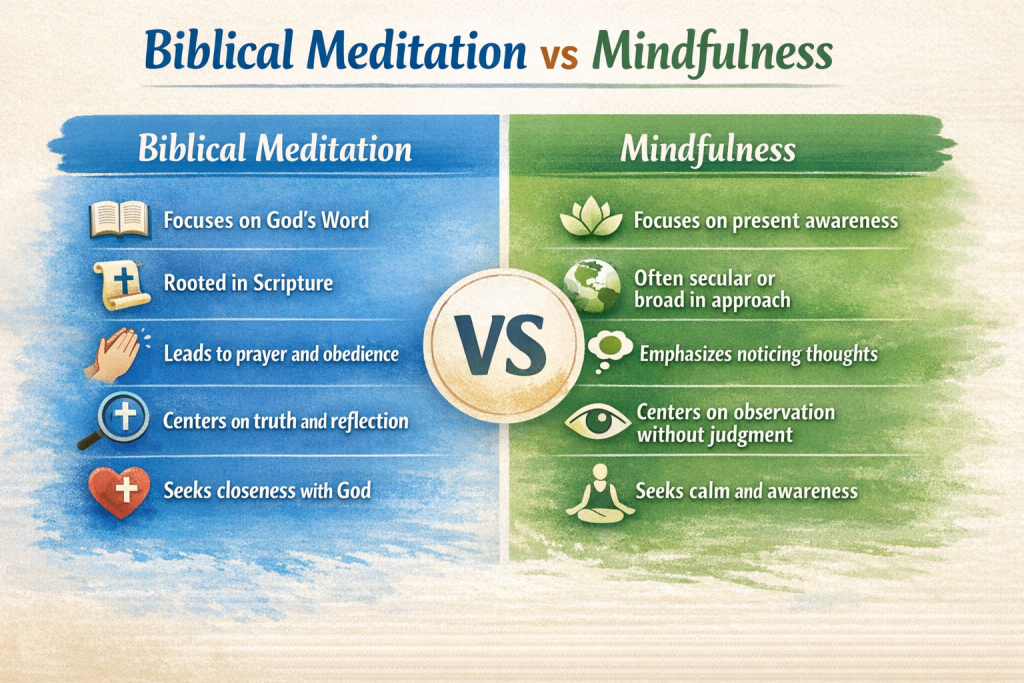
Biblical Meditation vs Mindfulness
There is some overlap here. Both practices encourage attention, slowness, and awareness.
But biblical meditation has a distinct center: God and His Word.
Mindfulness usually centers on noticing the present moment without labeling it as good or bad. Biblical meditation focuses on meeting God in the present moment through truth. One asks, “What am I noticing?” The other also asks, “What is God saying, and how should I respond?”
That difference matters. It gives biblical meditation direction, not just calm.
Common Biblical Meditation Mistakes to Avoid
Here is where people often get stuck:
- treating it like a productivity hack
- rushing through too much Scripture
- chasing emotional highs instead of truth
- judging every quiet time by how “deep” it felt
- confusing reflection with overthinking
One helpful reset is this: biblical meditation is not a performance review. You are not trying to impress God with your focus span.
You are simply learning to stay with Him a little longer.
What to Do When Your Mind Wanders
First, do not panic.
A wandering mind is not failure. It is part of the process. When you notice your thoughts drifting to emails, laundry, lunch, or that weird text from yesterday, gently come back.
Use one anchor:
- repeat the verse again
- write the key phrase down
- say a short prayer like, “Lord, bring me back”
- read the passage aloud
This is less like wrestling a tiger and more like guiding a puppy. Patiently. Repeatedly. With grace.
Tools That Can Support Biblical Meditation
You do not need gear for a meaningful quiet time. Still, the right tools can remove friction and help you stay consistent. At the time of writing, the Amazon picks below all showed strong ratings and substantial review volume.
Prayer Journal For Women: 52 Week Scripture, Guided Prayer Notebook For Women Of God
A structured journal with weekly Scripture guidance and space for reflection. Good for beginners who want prompts instead of a blank page staring back at them. Amazon’s search results showed about 4.7 stars and roughly 7,889 reviews.
Prayer Journal for Women: An Inspirational Christian Bible Journal, Prayer Notebook & Devotional (Premium Gold Spiral-Bound Hardcover)
This one works well if you like guided prayer, gratitude, and a more polished gift-style format. It showed about 4.8 stars and roughly 5,936 reviews in Amazon results.
The Prayer Map® for Women: A Creative Journal (Faith Maps)
A creative option that helps you map thoughts, requests, and reflections visually. Great for visual learners or anyone who prays better with structure. A related Amazon product page listed it at about 4.8 stars with roughly 2,765 reviews.
Mr. Pen- Bible Tabs, 75 Tabs, Dusty Lilac, Purple Foil
Not glamorous, but very practical. Bible tabs make it easier to get to passages fast, which oddly helps more than people admit. This listing showed about 4.7 stars and 1,861 reviews.
ESV Journaling Study Bible (TruTone over Board, Nubuck Caramel)
Best for readers who want study notes and room to write prayers, questions, and observations right beside the text. Amazon results showed a strong 4.8-star rating and thousands of reviews for this edition.
What Research Suggests About Spiritual Meditation and Mental Health
Research on biblical meditation specifically is still limited, so honesty matters here. Science has not neatly studied every version of sitting with Psalm 23 and a cup of coffee.
That said, a 2005 PubMed-indexed study on spiritual meditation, secular meditation, and relaxation found that participants practiced for 20 minutes a day over two weeks, and the spiritual meditation group showed stronger outcomes in areas like anxiety, mood, and pain tolerance. That does not prove that every Christian quiet time works the same way, but it does suggest that spiritually focused meditation may affect people differently than a purely secular approach.
A 2021 review of spirituality, religiousness, and mental health also found a generally positive relationship overall, especially in connection with depression, suicidality, and substance use, while noting that findings around anxiety were more mixed. The review also emphasized that the way a person uses faith in coping matters. In other words, faith-based practices can be supportive, but they are not automatic fixes, and unhealthy spiritual patterns can still be harmful.
FAQs
Is biblical meditation the same as emptying your mind?
No. Biblical meditation is about focusing your mind on God’s Word, not emptying it. You are redirecting attention, not shutting your thoughts down.
How long should biblical meditation take?
Start with 5 to 10 minutes. Consistency matters more than length. A short daily practice is far better than a one-hour session you never repeat.
What is a good Bible verse to start biblical meditation with?
Psalm 23:1, Psalm 46:10, Joshua 1:8, and Matthew 11:28 are all excellent starting points because they are short, memorable, and full of comfort.
Can I practice biblical meditation at night?
Yes. Morning is not more holy than evening. If bedtime is when your mind finally slows down, use that window. Psalm-based meditation works especially well at night.
Do I need a journal or devotional for biblical meditation?
No. A Bible and a willing heart are enough. Still, a journal or guided tool can help you stay focused and notice patterns in what God is teaching you over time.
Final Thoughts on Biblical Meditation
Biblical meditation is one of the simplest ways to bring your scattered thoughts back home.
It teaches you to slow down, stay with Scripture, and let truth sink deeper than a quick read ever could. You do not need perfect focus. You do not need fancy language. You do not need to feel profound every day.
You just need a verse, a few quiet minutes, and a heart willing to listen.
Start small today. Pick one passage. Sit with it. Turn it over in your mind. Pray it back to God. Peace rarely arrives like fireworks. More often, it comes like dawn—slow, steady, and real.