Tea Leaf Divination: 5 Herbs That Enhance Intuitive Insights
We may earn a commission for purchases made using our links. Please see our disclosure to learn more.
You know those moments when you feel an answer before you can explain it? Tea leaf divination (also called tasseography) gives that inner nudge a shape—literally—by reading the patterns left by tea leaves in a cup. In this friendly guide, you’ll learn a simple step-by-step method, the five herbs that tend to spark clearer insights, a small ritual that settles nerves and sharpens focus, and a short, research-backed section to keep your practice grounded (and calm).
Quick note: This article includes a few product picks I genuinely like. They’re common, easy to find, and beginner-friendly.
What Is Tea Leaf Divination (Tasseography)?
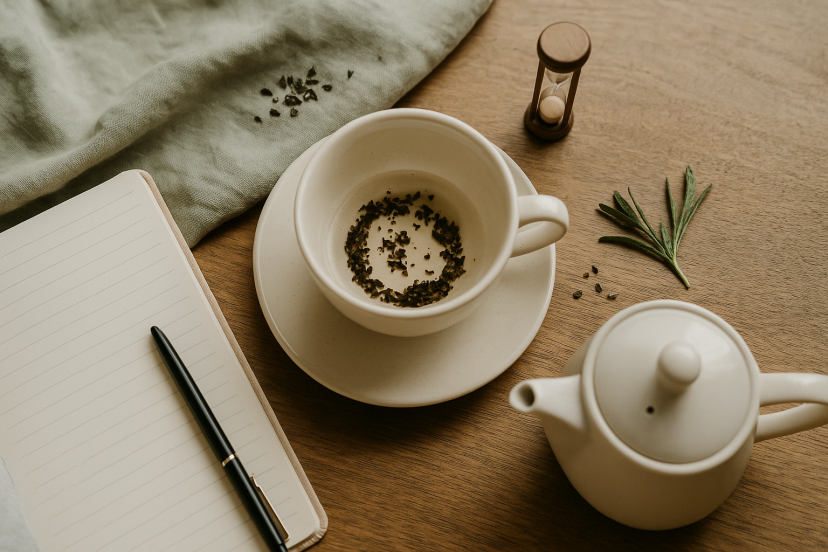
Tea leaf divination is the intuitive practice of interpreting shapes left by loose leaves after you drink a cup of tea. You’ll swirl the remaining liquid, invert the cup onto the saucer, then “read” the images, clusters, and lines that seem to appear. Think of it as visual journaling for your intuition—your mind connects the dots, and the symbols prompt memory, meaning, and guidance.
Why Ritual Helps You Tune In
Rituals sound mystical, but at heart they’re practical neuroscience. Repeated steps—boil, pour, breathe, swirl—give your nervous system a script. Studies show simple rituals can reduce anxiety, increase perceived control, and even improve performance under stress. That calmer baseline helps you notice subtle impressions instead of overthinking them.
Setting Up a Calm Reading Space (Tools + Atmosphere)
You don’t need much—just intention and a few basics:
- A light-colored cup with a plain interior (symbols are easier to see).
- A saucer (for the classic “flip and drain”).
- Loose-leaf tea (smaller leaves make more intricate maps).
- A kettle/teapot, a fine mesh infuser, and a notebook.
If scent helps you relax, you can lightly diffuse gentle botanicals. For a beginner’s primer on choosing quality scents and safe use, see this guide to organic essential oils—it covers purity, dilution, and simple blends without the overwhelm.
Tip: Dim screens, soften lighting, and put your phone on Do Not Disturb. Your attention is the most precious “tool” you own.
How to Choose Teas for Clarity
Your tea choice influences mood, breath, and attention:
- Green/white teas for “bright focus” (mild caffeine + L-theanine calm).
- Herbals for softer sessions at night.
- Aromatics (lavender, jasmine, rosemary) to nudge relaxation and imagery.
We’ll highlight five herbs next—each with a distinct feel for readings.
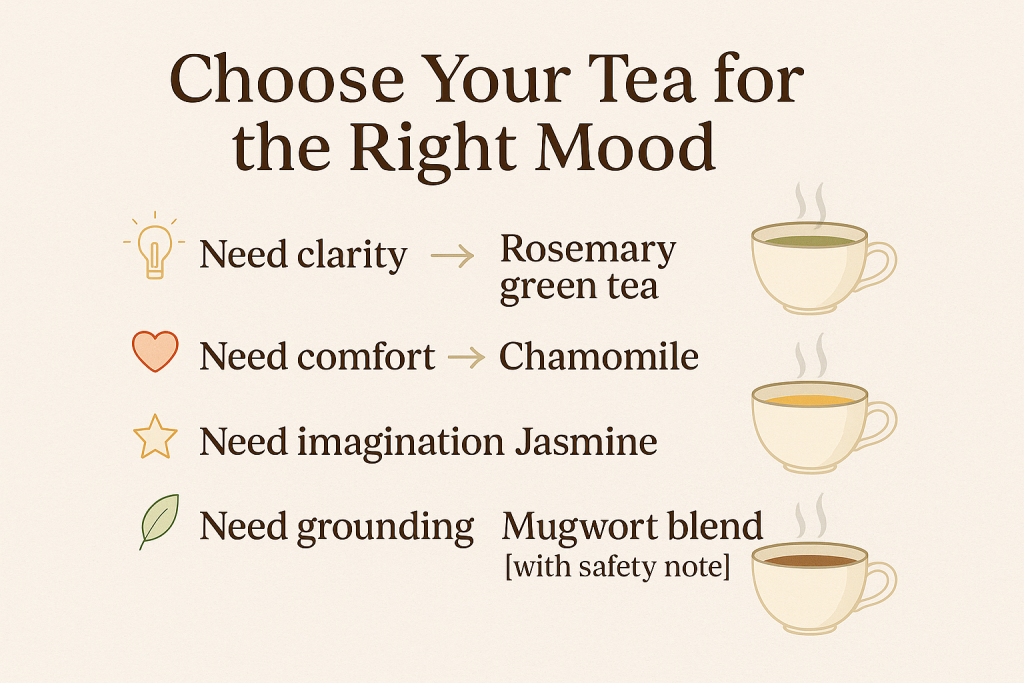
Herb #1: Mugwort (Dreamy, Liminal, Use With Care)
Mugwort (Artemisia vulgaris) has a long folk reputation for vivid dreams and liminal awareness. Many readers use it in blends rather than solo, because the flavor can be strong. Cautions: Avoid in pregnancy and if you’re ragweed-sensitive; always buy from trusted sources.
Best for: Night readings, dream journaling follow-ups, symbolic work.
Blend idea: 1 part mugwort + 2 parts chamomile + a pinch of mint.
Herb #2: Lavender (Soothing the Mind’s Noise)
Lavender’s gentle floral notes cue your body toward exhale. A calmer baseline helps you “hear” intuition without static. Meta-analyses suggest lavender aromatherapy can reduce anxiety and stress markers—exactly the state shift you want before a reading.
Best for: Pre-reading relaxation; evening sessions.
Use tip: Steep lightly (too much can taste soapy). Or keep lavender as an aroma in the room rather than in the cup.
Herb #3: Rosemary (Sharpness and “Snap”)
Rosemary’s camphorous brightness brings a clear, alert feel. Research has linked a rosemary constituent (1,8-cineole) and rosemary aroma with improved cognitive performance in healthy adults—handy when you want crisp pattern recognition.
Best for: Morning or mid-day readings; detail-heavy questions.
Blend idea: Green tea + rosemary + a curl of lemon peel.
Herb #4: Jasmine (Open, Imaginative, Heart-Forward)
Jasmine-scented green tea is a favorite for tea leaf reading: you get gentle caffeine for alertness, L-theanine for smooth focus, and a floral lift that feels imaginative without being spacey.
Best for: Big-picture questions; creative brainstorming.
Use tip: Keep water cooler (around 80°C/175°F) to avoid bitterness.
Herb #5: Chamomile (Grounded Calm and Soft Focus)
Chamomile’s apple-honey softness is lovely when you’re tired, worried, or reading before bed. It won’t push visuals; it makes space for them.
Best for: Reassurance, “What’s my next small step?” readings.
Blend idea: Chamomile + rose petals for heart-soothing comfort.

A Simple 7-Step Reading (Beginner-Friendly)
- Set an intention. One clear question is enough.
- Choose your tea. Aim for small loose leaves.
- Steep and sip. Leave a teaspoon of liquid and the leaves in the cup.
- Swirl three times clockwise. Breathe out.
- Invert onto the saucer. Let it drain 10–15 seconds.
- Turn the cup upright. Note shapes from rim (near future) downward (farther out).
- Journal one page. What did you notice? How does it connect?
Tiny imperfection is good. Don’t force a story—let the image “introduce itself.”
Interpreting Common Symbols (Quick Lexicon)
- Bird — Messages, news, synchronicity.
- Key — Access, solution, permission.
- Anchor — Stability; also “anchoring” if you’re clinging to the past.
- Bridge — Transition, safe crossing, support from others.
- Spiral — Growth patterns repeating; healing isn’t linear.
- Star — Guidance, hope, a “true north” moment.
- Wave — Change, emotion, move with the tide instead of bracing.
Ask: What’s the very first feeling this shape gives me? Your first thought is often the cleanest signal.
Troubleshooting “Cloudy” Readings
- Only seeing blobs? Use a lighter cup and smaller-cut tea.
- Mind racing? Breathe out longer than you breathe in for two minutes.
- Over-interpreting? Limit yourself to three symbols and one takeaway.
- No resonance? Close the session and return tomorrow—you’re not “losing” your intuition; you’re respecting it.
Research-Backed Boosters for Focus & Calm
- Calm focus via green-tea synergy. L-theanine (a green-tea amino acid) paired with caffeine can improve attention and reduce mind-wandering—a useful combo if you like daytime readings with gentle stimulation. Consider a light green tea instead of coffee before a session. (For an accessible overview, see this 2021 review of L-theanine + caffeine as a cognitive enhancer.)
- Aroma and attention regulation. Lavender shows evidence for easing anxiety; rosemary has been associated with sharper cognitive performance. Using aroma as a settling cue before you read can put you in the “calm-but-alert” zone that supports intuition.
- Ritual reduces jitters. Simple, repeated steps can lower anxiety and increase perceived control. Treat your setup as a micro-ritual, not a chore.
(Reminder: none of this is a medical claim; if you’re pregnant, nursing, or on medication, check with a healthcare professional before using new herbs.)
Amazon Picks to Build Your Reading Kit (5 Products)
These are well-reviewed, easy to source, and beginner-friendly.
1) The Cup of Destiny (Cup + Saucer + Guide Book)
A classic tasseography set with an Edwardian-style cup whose interior symbols help beginners build confidence.
- Features: Decorated cup, matching saucer, illustrated book.
- Pros: Purpose-built for divination; great training wheels.
- Cons: Symbols can nudge interpretation (some prefer plain cups).
- Best for: New readers who want prompts.
- Review snapshot: Praised for being “fun and instructional”; some wish the cup were larger.
2) Hiware 1000ml Glass Teapot with Removable Infuser
Stovetop-safe borosilicate glass with a stainless basket—perfect for loose leaves that create distinct patterns.
- Features: Drip-resistant spout, removable mesh infuser, 1L capacity.
- Pros: Clear glass shows leaf expansion; easy pour.
- Cons: Glass cools faster than cast iron.
- Best for: Everyday brewing and group readings.
- Review snapshot: Loved for value and visibility.
3) Finum Stainless Steel Brewing Basket (Medium)
A micro-mesh basket that fits most mugs—lets small leaves circulate and then strains them neatly.
- Features: Fine mesh, heat-tolerant frame, lid doubles as drip tray.
- Pros: Keeps tiny particles out; durable; dishwasher-safe.
- Cons: Basket edges can get hot; mind the lift.
- Best for: Single-cup sessions; precise steeping.
- Review snapshot: Frequently ranked a top infuser for clarity and ease.
4) Harney & Sons Assorted Tea Sampler
A mix of classics and herbals (including chamomile and peppermint) to test how different leaves affect your readings and mood.
- Features: Multi-flavor sampler; individually wrapped bags.
- Pros: Curated variety; approachable flavors.
- Cons: Bags, not loose leaf (still fine for learning symbols).
- Best for: Experimenting with taste + energy.
- Review snapshot: Reliable quality; a “gateway” to loose-leaf exploration.
5) Moleskine Classic Notebook (Large, Ruled)
Your readings will bloom when you track symbols, dates, and hits/misses in one place.
- Features: 5″×8.25″, elastic closure, archival paper.
- Pros: Durable; lies flat; easy to reference.
- Cons: Not waterproof (keep away from steamy kettles!).
- Best for: Building your personal symbol lexicon.
- Review snapshot: Loved for portability and longevity.
Quick Comparison
| Model / Set | Key Spec(s) | Warranty | Approx Price / Tier | Best For |
| The Cup of Destiny (cup+saucer+book) | Symbol-mapped interior; guide included | Varies by seller | $$ | Beginners wanting prompts |
| Hiware 1000ml Glass Teapot | Borosilicate; stainless infuser; 1L | Varies by seller | $ | Everyday brewing, clear viewing |
| Finum Brewing Basket (M) | Stainless micro-mesh; lid/tray | Varies by seller | $ | Clean single-cup steeps |
| Harney & Sons Sampler | Variety of classics/herbals | Varies by seller | $–$$ | Flavor + mood testing |
| Moleskine Classic Notebook | 192 ruled pages; elastic band | Varies by seller | $–$$ | Building a reading journal |
Price tiers are approximate ($ budget, $$ mid).
FAQs
How do I phrase the question for a reading?
Keep it open and actionable: “What quality do I need to embody this month?” or “What supports momentum in my career this quarter?” Avoid yes/no—invite images that show how.
Do I have to finish the whole cup?
No. Sip until you’ve enjoyed the moment, leave a teaspoon of liquid, and proceed. If your tea is too strong or hot, add a splash of cool water and keep going.
Can I use coffee grounds instead of tea?
You can. The method is similar, but coffee leaves denser patterns that some find harder to read. If you try it, use a lighter roast and a plain white cup.
Are decaf or herbal teas okay?
Absolutely. Many readers prefer herbals at night (chamomile, lavender) so the session ends restful. If you want “calm focus,” green tea’s L-theanine+caffeine balance is a nice middle ground.
What if I don’t see any symbols?
That’s normal. Your brain may be in “monitor mode.” Close the session kindly, write one line about how you feel, and revisit tomorrow. The practice “wakes up” with repetition.
Conclusion: Sip, See, Trust
Tea leaf divination isn’t about predicting every twist of life; it’s a practice for listening—patiently, kindly, curiously. Choose a tea that matches your energy, set a simple ritual, and let the leaves show you a symbol or two. Journal what lands. If it resonates, carry one small action into the week.
You already have intuition. The cup just gives it a canvas.