Types of Tarot Cards: Major vs Minor Arcana Guide

We may earn a commission for purchases made using our links. Please see our disclosure to learn more.
You open your first tarot deck and… it’s like meeting 78 new roommates at once. Everyone has a vibe. Some feel loud and dramatic (“Hi, I’m here to change your life!”), and others feel quiet and practical (“Did you drink water today?”).
If you’ve been searching for types of tarot cards, you’re probably in one of these spots:
- You want to learn tarot, but the deck structure feels confusing.
- You’re shopping for a deck and don’t know what style fits you.
- You keep hearing “Major Arcana” and “Minor Arcana” and nod like you understand. (Been there.)
By the end of this guide, you’ll know exactly how tarot is organized, what each card “type” does, and how to pick a deck that actually matches your brain—not just your aesthetic.
The simplest breakdown of the types of tarot cards
A standard tarot deck has 78 cards, split into two main categories (think: a movie’s main plot vs the daily scenes):
- Major Arcana (22 cards): big life themes, turning points, spiritual lessons
- Minor Arcana (56 cards): day-to-day stuff, relationships, work, mood, money, choices
If you remember nothing else today, remember this:
Major Arcana = the headline. Minor Arcana = the details.
A quick “why it matters” tip
When your reading has lots of Major Arcana, life is nudging you harder. When it’s mostly Minor Arcana, you’ve got more control through small decisions.
Major Arcana: the “big life” type of tarot card
Major Arcana cards are the ones that feel like a movie soundtrack swells behind them. They often show up when you’re learning a lesson, leveling up, or standing at a crossroads.
These cards represent archetypes (universal patterns): The Fool, The Lovers, The Tower, The Star… the icons.
How to recognize Major Arcana fast
- Usually numbered 0–21
- Often named with a strong, symbolic title
- The imagery feels “mythic,” like it’s telling a bigger story
What Major Arcana usually points to
- identity shifts
- life direction
- spiritual growth
- fate-like moments (or at least “this feels bigger than Tuesday” moments)
The 22 Major Arcana cards in plain English
Here’s the Major Arcana lineup as a quick reference—no gatekeeping language, just a friendly cheat sheet:
- 0 The Fool: new start, leap of faith
- 1 The Magician: skills, confidence, action
- 2 The High Priestess: intuition, inner knowing
- 3 The Empress: nurture, creativity, abundance
- 4 The Emperor: structure, leadership
- 5 The Hierophant: tradition, learning, beliefs
- 6 The Lovers: values + relationships, a choice
- 7 The Chariot: drive, willpower, direction
- 8 Strength: courage, soft power
- 9 The Hermit: reflection, solitude, wisdom
- 10 Wheel of Fortune: cycles, change, timing
- 11 Justice: fairness, truth, accountability
- 12 The Hanged Man: pause, perspective shift
- 13 Death: endings, transformation (not a doom card)
- 14 Temperance: balance, patience, blending
- 15 The Devil: attachment, temptation, shadow work
- 16 The Tower: shake-up, truth revealed
- 17 The Star: hope, healing, renewal
- 18 The Moon: uncertainty, intuition, illusion
- 19 The Sun: joy, clarity, success
- 20 Judgement: awakening, calling, rebirth
- 21 The World: completion, mastery, next chapter
Minor Arcana: the “daily life” type of tarot card
If Major Arcana is the big lesson, Minor Arcana is your group chat: feelings, stress, plans, awkward conversations, money stuff, boundaries, cravings, motivation.
Minor Arcana includes:
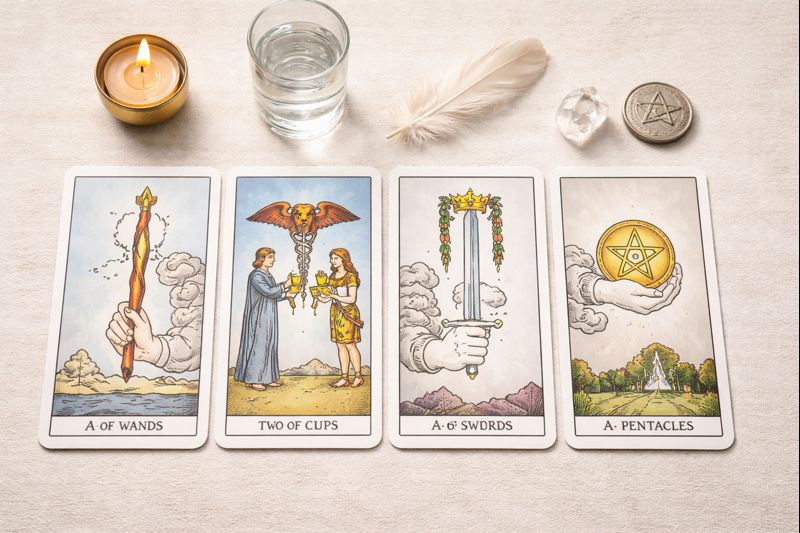
- four suits (like playing cards, but more symbolic)
- Ace through Ten (numbers = development)
- four court cards per suit (people/roles/energies)
Why Minor Arcana is secretly the best teacher
Because it gives you actionable feedback. It shows patterns you can tweak now—today, not “someday after your spiritual awakening.”
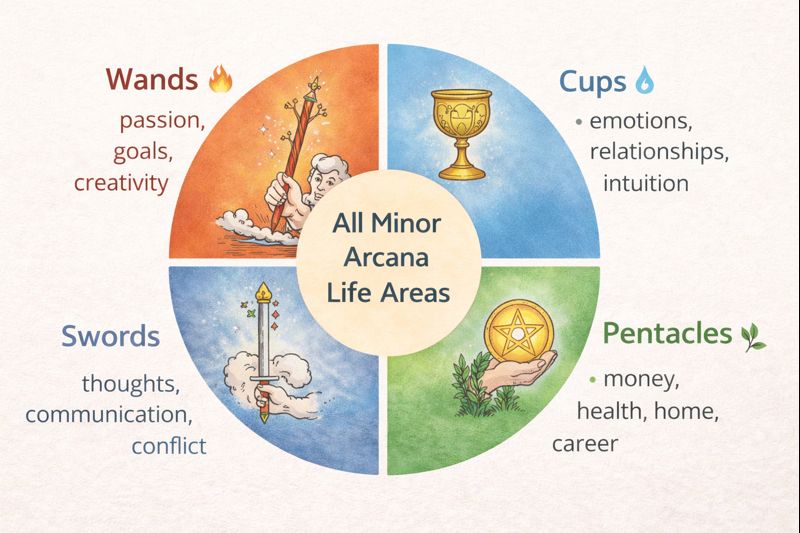
The four tarot suits and what they represent
Each suit maps to a life area. Different decks may use different symbols, but the core themes stay steady.
Wands
- Theme: passion, energy, creativity, ambition
- Feels like: “I want to do the thing—right now.”
Cups
- Theme: emotions, relationships, intuition, connection
- Feels like: “My heart has opinions.”
Swords
- Theme: thoughts, communication, conflict, truth
- Feels like: “Let’s talk about it… or overthink it.”
Pentacles
- Theme: money, work, body, home, long-term stability
- Feels like: “What’s the practical plan?”
Numbered cards (Ace through Ten): the “progression” type
Numbers in tarot act like a story arc.
A simple way to remember the flow
- Ace: seed / beginning
- Two: choice / balance
- Three: growth / collaboration
- Four: stability / pause
- Five: friction / challenge
- Six: harmony / adjustment
- Seven: tests / strategy
- Eight: movement / skill-building
- Nine: near-completion / intensity
- Ten: completion / overflow
So when you pull a Five, don’t panic. It often just means, “Yep, this is the part where it gets real.”
Court cards (Page, Knight, Queen, King): the “people and roles” type
Court cards confuse almost everyone at first, so let’s make them simple.
Three common ways to read court cards
- A person (you, them, your boss, your friend)
- An energy (how you’re acting or should act)
- A role (student, doer, nurturer, leader)
A super practical court card cheat
- Page: curious learner / messages / “new at this”
- Knight: action, pursuit, intensity (sometimes chaos)
- Queen: inner mastery, embodiment, emotional intelligence
- King: external mastery, leadership, responsibility
Major vs Minor: which type of tarot card matters more in a reading?
Here’s a rule that keeps readings grounded:
- Major Arcana sets the theme.
- Minor Arcana shows how it plays out.
If you pull The Lovers (Major) plus a bunch of Swords (Minor), the theme may involve values and relationships… and the “how” involves communication, clarity, or conflict.
A quick weighting trick
If 3+ Major Arcana show up in a short spread, pay attention. Life is trying to get your attention with a megaphone.
Tarot deck “systems”: Rider-Waite-Smith, Thoth, and Marseille
This is where the shopping side of types of tarot cards comes in.
Different systems are like different dialects of the same language.
Rider-Waite-Smith (RWS) style
- Most beginner resources use it
- Minor Arcana often shows illustrated scenes (very learnable)
Thoth style
- Rich with esoteric symbolism (astrology, qabalah, alchemy)
- Can feel intense—but brilliant if you like depth
Marseille style
- Older European tradition
- Many “pip” cards (numbered cards) use repeating symbols, not scenes
Illustrated scenes vs “pip” cards
This is a sneaky-big difference in tarot types.
Illustrated decks
- Show story scenes on many Minor Arcana cards
- Great for intuitive, visual learning
Pip-style decks
- Use repeating suit symbols (like 6 swords, 7 cups)
- Great if you like structure, numerology, and pattern thinking
- Harder at first if you rely on visuals
If you’re a visual learner, start with illustrated scenes. You can always “graduate” to pip decks later.
Modern themed decks: what changes (and what doesn’t)
You’ll see decks themed around everything: cats, cottagecore, anime, space, mythology, pop culture.
Here’s the truth:
The imagery changes, but the structure stays. You still have Major Arcana + Minor Arcana + suits + courts.
A gentle note on culture and symbolism
Some decks borrow heavily from cultures they don’t belong to. If something feels like a costume rather than respect, trust that feeling and choose differently.
And if you’re drawn to softer, nurturing archetypes and self-worth themes, this guide on divine feminine energy fits beautifully into tarot-based self-reflection.
Reversed cards: a “different type” or just a different angle?
Reversals (upside-down cards) aren’t a separate type of tarot card—but they do change how you read.
Three beginner-friendly ways to read reversals
- Blocked energy: it’s there, but stuck
- Inner experience: happening internally vs externally
- Needs attention: the lesson is “active”
If reversals stress you out, you can skip them. Tarot should feel helpful, not like a pop quiz.
Tarot vs oracle vs Lenormand (so you don’t buy the wrong thing)
People often say “tarot cards” but mean “any mystical deck.” These are different tools.
- Tarot: structured 78-card system (Major/Minor Arcana)
- Oracle: flexible structure (could be 36, 44, 60 cards—anything)
- Lenormand: 36-card fortune-telling system with very direct meanings
If you want to learn a classic system with tons of resources, tarot is a great start.
How to choose the best deck for your learning style
This is the commercial part—because the right deck makes learning smoother.
Ask yourself these three questions
- Do I learn visually?
If yes: choose an illustrated RWS-style deck. - Do I like deep symbolism?
If yes: consider Thoth-based decks or detailed guidebooks. - Do I want gentle vibes or blunt truth?
Deck tone matters. Some decks feel like therapy. Others feel like a strict coach.
Two quick quality checks
- Card stock should feel sturdy (not flimsy)
- Guidebook should be readable (not a cryptic poem)
Product picks: 5 Amazon tarot products worth it
Affiliate disclosure: If you buy through these links, I may earn a small commission at no extra cost to you.
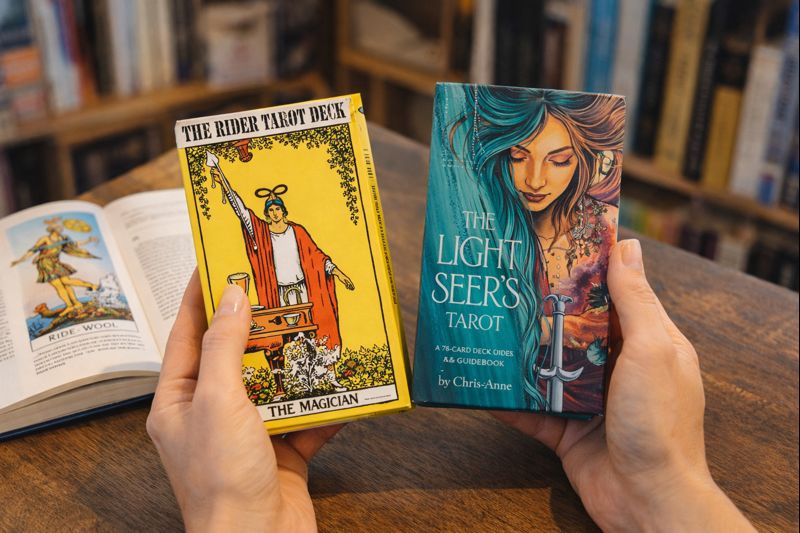
1) The Rider Tarot Deck® (Rider-Waite-Smith)
Why it’s a staple: It’s the reference point for most tarot learning materials.
Features: classic imagery, beginner-friendly structure, massive community support
Best for: first-time readers who want the “standard” deck
Why it fits the criteria: It’s widely rated 4.8/5 with 24,639 ratings.
2) The Light Seer’s Tarot: A 78-Card Deck & Guidebook
Why people love it: modern artwork + emotional clarity (great for self-reflection).
Features: contemporary characters, light/shadow themes, approachable guidebook
Best for: intuitive readers, journaling types, “therapy but make it mystical” energy
Why it fits the criteria: Commonly listed around 4.8/5 with ~4.3K ratings.
3) Crowley Thoth Tarot Deck (Large Edition)
Why it stands out: symbolism-rich, intense, and endlessly layered.
Features: large-format cards, deep esoteric system, iconic art by Lady Frieda Harris
Best for: advanced beginners who want depth (and don’t mind studying)
Why it fits the criteria: Shown at 4.7/5 with 2,522 ratings.
4) The Wild Unknown Pocket Tarot
Why it’s a vibe: nature symbolism, minimalist feel, very portable.
Features: pocket size, strong animal/element imagery, great travel deck
Best for: readers who connect with nature and symbolism over “people scenes”
Why it fits the criteria: Listed at 4.8/5 with ~3.1K ratings.
5) Seventy-Eight Degrees of Wisdom (Rachel Pollack)
Why it’s worth it: It’s basically a long-term tarot companion—especially for learning meanings and nuance.
Features: deep explanations, psychological angle, strong reference style
Best for: anyone who wants to go beyond keywords and read with depth
Why it fits the criteria: Referenced at 4.8/5 with 3,767 ratings.
Research-backed: why tarot “works” as a self-reflection tool
Even if you treat tarot as symbolic storytelling (not fortune-telling), it can still be genuinely helpful—because it gives your mind a structured language to talk about what it already senses, but hasn’t fully named yet.
In Tarot as a Projective Technique (Semetsky, 2006), Semetsky frames tarot like a projective prompt (think: a guided mirror). The cards don’t “hand you a destiny”—they spark associations, memories, and meaning-making that can lead to insight when you reflect honestly.
And in Tarot Cards: An Investigation of Their Benefit as a Tool for Self Reflection (Hofer, 2009), Hofer explores tarot in a reflective/therapeutic context, describing how tarot imagery can help people clarify situations, surface emotions, and consider practical next steps.
How to use that in a reading (no pressure, no “woo” required):
- Name it: What part of my life is this card describing?
- Own it: What feeling or need is trying to be heard?
- Act on it: What’s one small, kind step I can take this week?
Bottom line: tarot can be a mirror—not because the cards “force” a future, but because symbols invite the kind of honest questions that lead to real clarity.
FAQs about types of tarot cards
What are the main types of tarot cards?
The main types of tarot cards are Major Arcana (22 big-life cards) and Minor Arcana (56 everyday-life cards). Minor Arcana includes four suits, number cards, and court cards.
How are Major Arcana and Minor Arcana different?
Major Arcana points to major themes and life lessons. Minor Arcana points to daily choices, emotions, conversations, and practical situations.
Are court cards their own type of tarot card?
Yes—court cards (Page, Knight, Queen, King) are a distinct group within the Minor Arcana. You can read them as people, roles, or energies.
Is an oracle deck the same as tarot?
No. Tarot follows a structured 78-card system. Oracle decks vary in size and structure, so the “types” of cards depend on the specific oracle deck.
What kind of tarot deck should a beginner start with?
Most beginners do best with a Rider-Waite-Smith style deck with illustrated Minor Arcana scenes, because it’s easier to learn and has the most learning resources.
Conclusion
Once you understand the types of tarot cards, tarot stops feeling like a mystery box and starts feeling like a map: Major Arcana for the big lessons, Minor Arcana for the daily moves, suits for life areas, and court cards for people and roles.
So go easy on yourself as you learn. Tarot isn’t about being “psychic enough.” It’s about becoming honest enough to ask better questions—and brave enough to listen to the answers.