
Tarot Cards for Beginners: How to Choose Your First Deck

We may earn a commission for purchases made using our links. Please see our disclosure to learn more.
Choosing your first tarot deck sounds simple until you see hundreds of options with different artwork, sizes, and guidebooks. Some look traditional and mysterious; others feature modern characters, animals, or bold colors. So which tarot cards for beginners will actually help you learn instead of leaving you guessing?
A good first deck should make the pictures easy to interpret, feel comfortable in your hands, and give you reliable instructions when a card’s meaning isn’t obvious. You need cards you’ll enjoy using and a practical way to understand them.
This guide compares the main deck styles, explains the features worth paying attention to, and recommends five distinct options for different learning preferences.
What Beginners Should Know Before Buying a Tarot Deck
Tarot is a symbolic card-reading system. People use it for spiritual exploration, storytelling, and personal reflection, although its ability to predict events has not been scientifically established. You can also use the images to reconsider a question.
Before choosing, decide whether you want to study traditional symbols, keep a daily journal, or explore a visual theme. That narrows the options quickly. Choose a deck that feels approachable now. The best learning tool is one you’ll pick up again tomorrow.
How a Standard Tarot Deck Works
A traditional tarot deck contains 78 cards. The 22 Major Arcana cards, including The Fool and The Star, typically represent broad experiences or turning points. The 56 Minor Arcana cards cover more everyday themes through four suits: Cups, Wands, Swords, and Pentacles.
Each suit includes ten numbered cards along with four court cards: the Page, Knight, Queen, and King.
For a closer look at the structure, see our guide to the types of tarot cards. Understanding those groups makes unfamiliar decks much less intimidating.
Rider–Waite–Smith vs. Modern and Themed Decks
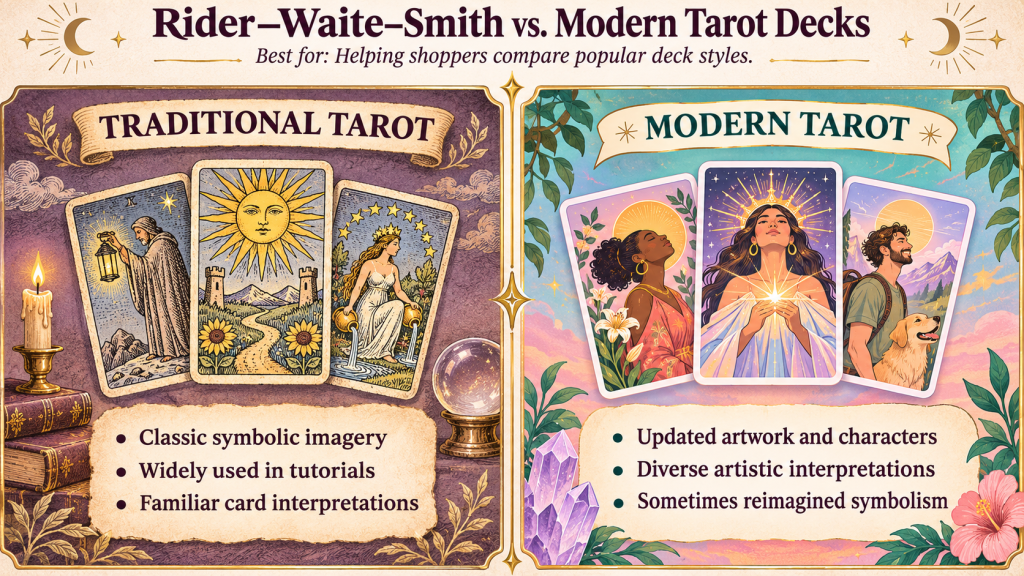
The Rider–Waite–Smith system is a strong starting point because its illustrated scenes appear throughout the deck, including the numbered Minor Arcana. Many tutorials discuss these pictures, making lessons easier to follow.
Modern decks often keep the same structure while changing the clothes, settings, and characters. Themed decks may draw on mythology, fantasy, or nature instead. Heavily reimagined scenes may require extra guidebook reading.
If learning alongside online lessons matters most, prioritize imagery that stays close to the classic system.
Tarot Cards vs. Oracle Cards: Which Should You Buy?
Tarot and oracle cards aren’t interchangeable. Tarot usually follows the 78-card Major and Minor Arcana structure. Oracle decks have no single required number of cards, suits, or meanings; each creator decides how the system works.
Choose tarot if you want a widely taught framework with reusable skills. Choose oracle cards if you prefer a themed set of prompts that is easier to explore without studying traditional symbolism.
Check descriptions carefully: an oracle deck won’t teach traditional tarot reading.
How to Choose Tarot Cards for Beginners
Start with the artwork rather than the box. Can you distinguish the people, actions, and emotional tone on several sample cards? Pictures that tell a recognizable story are easier to interpret than decorative symbols alone.
Next, consider your learning style. A visually detailed deck suits someone who likes to study scenes; a simpler design might help someone who gets distracted by crowded illustrations.
Finally, check that the deck is complete, includes useful instructions, and matches the kind of reading you want to practice. Start with one thoughtfully chosen set.
What to Look for in Card Size and Quality
Card dimensions affect handling more than beginners expect. Standard-size cards show artwork clearly but may be awkward to shuffle with smaller hands. Mini decks travel easily and take up less table space, although small text and symbols can be harder to see.
Look for readable printing, consistent card backs, and edges that don’t immediately catch during shuffling. A protective box helps with travel.
Examine photographs and stated dimensions; “standard” doesn’t guarantee identical sizing.
Why a Useful Guidebook Matters
A good guidebook explains what the cards represent and offers examples of how to combine them into a reading. Beginners particularly benefit from clear descriptions of the Major Arcana, the four suits, and one-card or three-card spreads.
Short booklets work for reference; detailed guides better explain unusual artwork. With themed decks, look for explanations that connect each illustrated character or story to traditional card meanings. Otherwise you may need another reference book to understand the artwork.
Check whether the included instructions are printed or digital, what language they’re written in, and whether they cover every card.
Five Recommended Tarot Cards for Beginners
These five complete decks address different priorities: traditional instruction, contemporary art, portability, reflective imagery, and storytelling.
1. U.S. Games Systems Rider-Waite Tarot Deck
Best for: Learning traditional card meanings with books and tutorials.
This 78-card edition uses Pamela Colman Smith’s classic illustrations, including fully pictured Minor Arcana scenes. Its familiar symbols make comparisons with beginner teaching materials straightforward, and it includes an instruction booklet. The traditional art may feel dated to some readers, while the booklet is better suited to quick reference than extended lessons.
2. The Modern Witch Tarot Deck by Lisa Sterle
Best for: Readers who want contemporary, inclusive imagery.
Lisa Sterle reinterprets the Rider–Waite–Smith system using modern fashion, diverse characters, and expressive color. The set contains 78 cards and a hardcover guidebook, giving beginners a recognizable framework with more contemporary scenes. Its strong visual style is the main attraction, but some readers may still prefer the classic artwork shown in older tutorials.
3. Everyday Tarot Mini Tarot Deck by Brigit Esselmont
Best for: Small hands, travel, and short daily readings.
This compact set includes 78 illustrated cards measuring 2.5 by 3.5 inches, an 88-page mini guide, and a magnetic-closure box. Its portable format makes it convenient for a quick card pull away from home. The trade-off is that the smaller illustrations and book pages may be less comfortable for detailed study.
4. Light Seer’s Tarot: A 78-Card Deck & Guidebook by Chris-Anne
Best for: Reflective readings with expressive, modern scenes.
Chris-Anne’s 78-card deck reimagines traditional tarot archetypes through colorful characters and emotionally detailed artwork. An accompanying guidebook helps readers connect the images with familiar card themes. It is an appealing choice for someone drawn to personal reflection, although the reinterpretations can be less convenient when following lessons that show the original Rider–Waite–Smith illustrations.
5. Tarot of the Divine by Yoshi Yoshitani
Best for: Story lovers interested in world mythology and folklore.
Yoshi Yoshitani illustrates the traditional tarot structure through folktales, deities, and fairy tales from different cultures. Its companion guidebook connects those stories to familiar tarot themes, offering a memorable route into symbolism. Readers unfamiliar with the source tales may need more context, making this a better choice for curious learners than those seeking the simplest visual reference.
How to Start Reading With Your First Deck
Begin with a specific, open-ended question such as, “What should I pay attention to in this situation?” Shuffle the cards however feels comfortable, draw one, and describe what you notice before consulting the guidebook.
Look at the character’s posture, the setting, and the action taking place. Then compare your interpretation with the published meaning. Use the result to explore questions you may have overlooked.
Record your first impressions for later.
Three Simple Tarot Spreads to Try
A spread is simply an arrangement of cards, with each position representing a different question. Start small so you can think about relationships between cards rather than managing a complicated layout.
- One card: What perspective might help me today?
- Two cards: What is the challenge, and what could support me?
- Three cards: What is happening, what deserves attention, and what practical step could come next?
These positions are flexible prompts. Adapt them to work, relationships, or creative projects.
How to Interpret Cards Without Memorizing Everything
You don’t need to memorize 78 meanings before doing a reading. Start with the image and identify one or two details that relate to your question. Then check the guidebook for the conventional interpretation.
Consider The Fool, often associated with beginnings and taking a step into the unknown. In a hypothetical reading about a new hobby, it might prompt you to ask whether you’re open to being inexperienced.
When a card seems confusing, record your reaction rather than force an explanation.
Common Beginner Buying and Reading Mistakes
One frequent mistake is choosing a deck solely because the packaging is beautiful, without checking sample cards or the included guide. Another is confusing oracle sets with standard tarot.
During readings, avoid asking the same question repeatedly until you receive a preferred card. That can encourage overinterpreting random draws. Unsettling cards needn’t predict disasters: Death often symbolizes change.
Keep readings proportionate. Important health, financial, or legal decisions need appropriate evidence and qualified advice, not a card draw.
What Research Actually Shows About Tarot Readings
Scientific evidence does not establish tarot as a reliable way to predict events or reveal hidden facts. In Susan Blackmore’s 1983 experimental study of tarot readings, people rated face-to-face interpretations highly, but could not reliably identify their own reading among others when personal cues were removed. The experiments concerned personality interpretation, not future prediction, and their small samples limit generalization.
A 2018 Fordham University dissertation on divination practices instead explored how people experience readings, using interviews and observation. Participants described insight, validation, and playfulness; those accounts do not demonstrate medical or predictive effectiveness.
The practical distinction is simple: choose a deck for meaningful reflection or spiritual practice, not a guarantee of factual answers.
Frequently Asked Questions About Tarot Cards for Beginners
Which tarot deck is easiest for a complete beginner?
A traditional Rider–Waite–Smith deck is usually the easiest starting point because many beginner guides use its illustrations. If you dislike the classic appearance, a close modern adaptation can work just as well. Check whether the artwork supports the meanings you’re learning and whether the guidebook offers explanations you can understand.
Do I need to be spiritual to use tarot cards?
No. Some readers use tarot within spiritual traditions, while others treat it as a creative reflection exercise. Explore symbols and journal without adopting any particular belief. For example, you might use a card as a prompt to consider different responses to a difficult conversation.
Is it better to buy a tarot deck with keywords printed on the cards?
Printed keywords can help you recall traditional associations without opening a booklet. However, they may also steer you toward one interpretation before you’ve studied the image. Choose keywords for quick prompts; use uncluttered cards to practice reading imagery. Both approaches are valid for learning.
Can I read tarot cards for myself every day?
Yes, daily one-card readings are a manageable way to become familiar with your deck. Try keeping a short journal of the question, the card, and your interpretation. If readings create anxiety or compulsion, take a break and make decisions using practical information.
Should I learn reversed tarot cards immediately?
No. Reversed cards are cards drawn upside down, and different tarot traditions interpret them differently. Beginners can read every card upright while learning the main symbols and suit patterns. Once you feel confident, experiment with reversals as a possible blocked, internal, or contrasting expression of the upright meaning rather than an automatic negative prediction.
Conclusion: Choosing the Best First Tarot Deck
The best tarot cards for beginners are the ones you can understand, handle comfortably, and enjoy returning to. Before buying, inspect sample artwork, confirm the deck has a complete tarot structure, and look closely at the guidebook. Size and portability matter, but not as much as being able to learn from the images.
For the clearest match with traditional lessons, start with the U.S. Games Systems Rider-Waite Tarot Deck. If classic artwork doesn’t appeal to you, The Modern Witch Tarot Deck offers a more contemporary interpretation without abandoning the familiar system. A smaller or story-driven deck can make more sense if that suits your routine.
Choose one complete deck, practice simple readings, and let experience guide any future additions to your collection.