
Best Tarot Journals to Track Readings & Intuition

We may earn a commission for purchases made using our links. Please see our disclosure to learn more.
Ever do a tarot reading, feel so sure… and then two days later you’re like, “Wait—what did I even pull? And why did it hit so hard?” 😅
That’s exactly where a tarot journal becomes your secret weapon. It helps you remember your spreads, track patterns, and build trust in your intuition without turning tarot into homework.
In this guide, I’ll show you what to write (even if you’re inconsistent), what layouts actually work, what to look for when buying a tarot journal, and a few solid Amazon picks if you want something ready to go. (Quick note: this post may include affiliate recommendations.)
Why a tarot journal makes readings clearer
A tarot journal is basically your “receipts folder” for your spiritual life. Not in a gotcha way—more like: proof that you’re learning, growing, and noticing real patterns.
When you write things down, you stop relying on hazy memory (which loves to rewrite stories). You also start seeing repeat cards, repeat themes, and repeat triggers—aka the stuff your deck has been trying to tell you for weeks.
And honestly? A tarot journal is the gentlest way to build confidence. You don’t need to “be psychic.” You just need to pay attention.
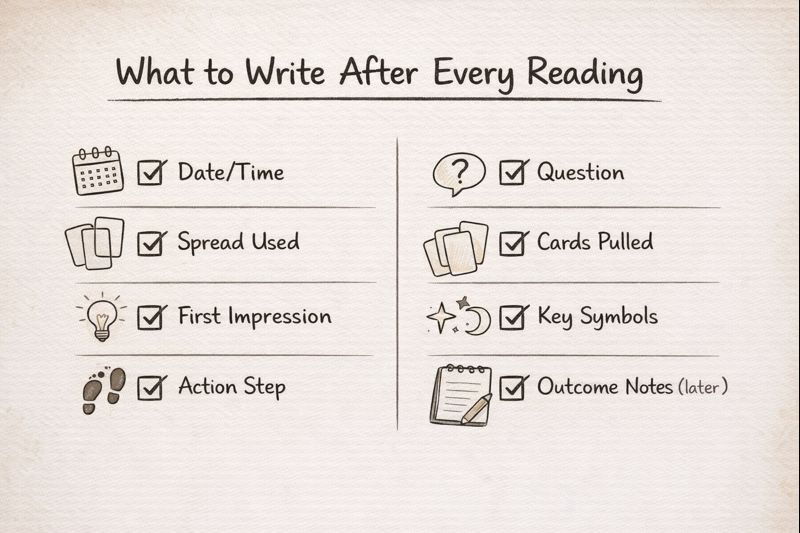
What to write after every reading (your “receipt”)
If you only write five things, make it these:
- Date + time (energy can shift fast)
- Question (the real question, not the polite version)
- Spread used (even “3-card” counts)
- Cards pulled (include reversals if you read them)
- Your first impression (before you Google anything)
Then add one more line: “What’s happening in my life right now?”
That context is gold later.
Think of it like taking a photo of your emotional weather. Future-you will understand the forecast way better.
Tarot journal layouts that actually work
You don’t need a fancy system—but having a repeatable page style makes you more consistent.
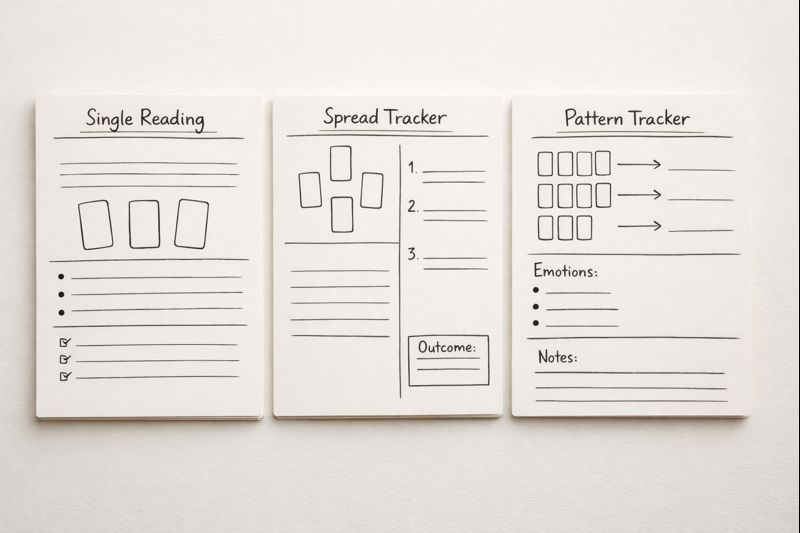
Option A: The simple “one-page reading”
Great if you read often.
- Question
- Cards + quick meanings
- Story (2–6 sentences)
- Action step (one thing you’ll do)
Option B: The “spread tracker” format
Great if you use the same spreads again and again.
- Spread name + positions
- Card in each position
- Position meaning + your interpretation
- Outcome notes (leave space to return later)
Option C: The “pattern detective” page
Great if you’re seeing repeats.
- Repeat cards showing up
- Emotions they trigger
- Situations they show up in
- What the pattern might be teaching you
Guided tarot journal vs blank notebook
This is the big buying question.
Guided tarot journals are amazing when:
- you freeze up and don’t know what to write
- you want prompts, structure, and tracking pages
- you’re building a habit
Blank notebooks are perfect when:
- you already have your own system
- you want freedom (messy notes, sketches, symbols)
- you like creating your own spreads and templates
My honest take: if you’re still building consistency, guided is easier. If you’re already reading regularly, blank can feel more “you.”
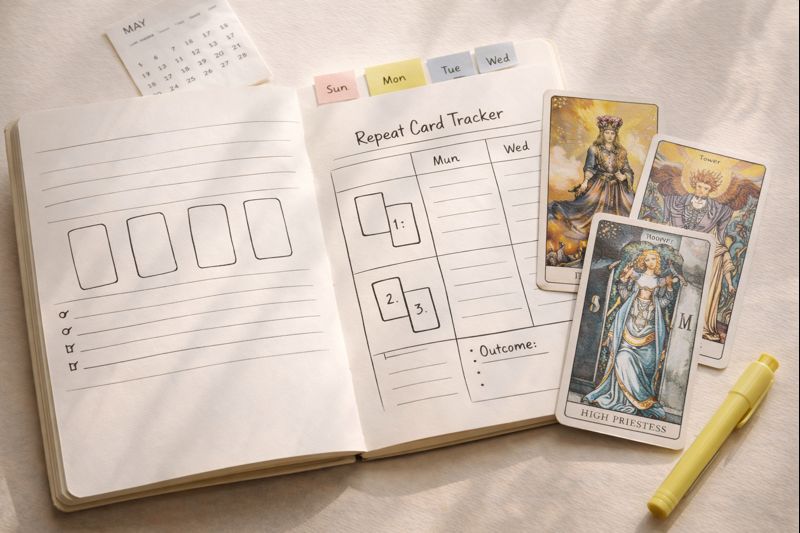
Buying checklist: features worth paying for
If you’re shopping for a tarot journal (or a notebook you’ll use as one), here’s what actually matters:
- Paper quality (90–120 GSM) so ink doesn’t ghost through
- Lay-flat binding (spiral or stitched is usually best)
- A size you’ll carry (A5 is the sweet spot for most people)
- Built-in trackers if you want to log outcomes and repeats
- A pocket or bookmark because tarot people collect tiny things (it’s a law)
Also: don’t underestimate the “I want to open this” factor. If the cover feels special, you’ll use it more.
Tarot journal prompts for beginners
If you’re staring at a blank page like it personally insulted you, try these.
Quick prompts (low effort, high insight)
- What emotion did this reading bring up first?
- What’s the simplest message here?
- What am I avoiding naming out loud?
Intuition-building prompts
- If I had to explain this reading to a friend, what would I say?
- What symbol in the card feels loud today?
- What would this card mean if I didn’t look anything up?
Decision prompts (when you’re stuck)
- What’s the likely outcome if I do nothing?
- What is a simple action I can do this week?
- What boundary does this reading want me to set?
Write like you’re texting a wise friend. Not like you’re writing a thesis.
How to track spreads, reversals, and clarifiers
Tracking doesn’t have to be complicated.
Here’s a clean way to log things without turning your tarot journal into a spreadsheet:
Spreads
Write the spread name, then label positions like:
- Past
- Present
- Advice
- Outcome
Reversals
Pick one meaning for reversals and stay consistent. Examples:
- blocked energy
- internal version of the card
- the shadow side of the card
Write your reversal “rule” once on the first page of your tarot journal. That way you’re not reinventing it every time.
Clarifiers
Only pull clarifiers when you can name why:
- “I don’t understand the advice.”
- “I need context for the outcome.”
- “What’s the hidden factor?”
Then label the clarifier clearly, so later you know what it was clarifying.
Logging outcomes: patterns, timing, and “aha” moments
This is where your tarot journal becomes powerful.
Instead of rating a reading “right” or “wrong,” track:
- What happened afterward
- How you felt
- What choice you made
- What you learned
A simple method:
- 24 hours later: “What shifted?”
- 7 days later: “What played out?”
- 30 days later: “What was this really about?”
Tarot isn’t always literal. Sometimes the “prediction” is actually a mirror. Journaling helps you catch that.
A 5-minute daily tarot journal routine
If you want a sustainable habit, keep it tiny.
Try this daily tarot journal flow:
- Pull one card
- Write three keywords
- Answer: “Where is this showing up today?”
- End with one line: “Today I will…”
That’s it. Five minutes.
You’ll be shocked how quickly your tarot journal starts sounding like a conversation with your future self.
Turning notes into intuition
A tarot journal doesn’t just store information—it trains your inner voice.
Here’s the trick: always write your first impression before you check a guidebook.
Even if it feels “wrong.” Even if it’s weird.
Because intuition often speaks in:
- images
- body sensations
- random memories
- feelings that don’t have logical reasons yet
Over time, you’ll notice your first impressions are usually the most honest ones. The journal proves it.
Shadow work with a tarot journal without spiraling
Shadow work can be healing… or it can turn into emotional doom-scrolling in notebook form.
So here’s your guardrail:
- write the truth
- and write the next kind step
A shadow-work entry can look like:
- What did this card trigger?
- What story am I believing?
- Where did I learn that story?
- What would compassion say instead?
If you pull something intense (hello Tower), end your entry with a grounding line:
- “I am safe in this moment.”
- “I can take this one step at a time.”
- “I don’t need to solve my whole life tonight.”
Privacy + protection: keeping your practice grounded
Some readings feel tender. Some feel heavy. And sometimes you don’t want everyone in your house accidentally flipping to “my deepest fear + why I date like that.” Fair.
A few easy protections:
- Keep your tarot journal in a drawer, bag, or wrapped cloth
- Use a small symbol on entries you want private (like 🔒)
- Write in shorthand if you’re worried about snooping
- Do a quick grounding breath before and after intense readings
And if you’ve been feeling energetically “off,” anxious, or unusually drained, it can help to read about spiritual attack signs and practical ways to protect your energy—not to scare yourself, but to stay centered and supported.
5 Product picks to upgrade your tarot journal setup
These are popular, practical options that work well for tarot journaling—whether you want a true tarot journal or a beautiful notebook + tools.
1) Tarot Journal for Beginners: Reflect, Record, and Track Your Tarot Card Readings
A beginner-friendly guided option that gives you structure right away. It’s especially helpful if you’re still learning how to describe a reading in your own words.
Features: guided pages, simple tracking format
Best for: new readers who want “tell me what to write” support
2) The Tarot Journal (Peter Pauper Press)
A polished, giftable journal with strong buyer love and a more “keepsake” vibe.
Features: dedicated tarot journaling pages, durable build
Best for: readers who want something beautiful and consistent
3) PAPERAGE Dotted Journal Notebook (100 GSM, hardcover)
Not tarot-specific, but dotted pages are perfect for drawing spreads, tracking symbols, and designing your own layouts—without the pressure of blank pages.
Features: thick paper, dot grid, hardcover
Best for: creative readers who want flexibility
4) Mr. Pen Dual Tip Aesthetic Highlighters (12 pack)
Color-coding makes patterns pop fast (repeat suits, major arcana streaks, themes like love/money/health).
Features: dual tips, soft “aesthetic” tones
Best for: visual organizers and pattern spotters
5) Tarot Stickers Pack (100 pcs)
If decorating your pages makes you more likely to journal… lean into it. Stickers can turn your tarot journal into a space you actually want to open.
Features: themed tarot imagery, easy to use
Best for: scrapbook-style journaling and mood tracking
What science says about writing and mental clarity
A tarot journal isn’t a clinical tool—but the act of journaling has real research behind it, especially around emotion regulation, stress, and meaning-making.
One example: a 12-week online positive affect journaling trial (JMIR Mental Health, 2018) had participants write for 15 minutes, 3 times a week, and the journaling group saw reduced mental distress and lower anxiety symptoms compared with usual care. Here’s the source: positive affect journaling study (JMIR, 2018).
And on the bigger-picture side, a systematic review and meta-analysis comparing expressive writing and positive writing looked at 24 randomized trials (1,558 participants) and found writing-based interventions can support mood and cognitive processing depending on the prompts and population. Source: expressive writing vs positive writing meta-analysis (2023).
So no, journaling doesn’t magically fix everything. But it does help you process, notice, and integrate—and that’s basically what a tarot journal is for.
Tarot journal FAQs
How do I start a tarot journal if I’m a total beginner?
Start tiny: date, question, cards, and your first impression. That’s enough. Consistency matters more than fancy pages.
What should I write in my tarot journal when a reading confuses me?
Write what confused you—then write two possible interpretations. End with: “What would I notice if this were true?” Confusion often means the message needs context.
Do I need a different tarot journal for love, career, and spiritual readings?
You don’t need to, but some people love separating journals by theme. If you get overwhelmed easily, one journal is simpler.
How often should I review my tarot journal notes?
Aim for once a week or once a month. Look for repeats: cards, suits, topics, or the same advice showing up in different outfits.
Is a digital tarot journal better than a paper one?
Digital is searchable and quick. Paper feels more embodied and intuitive. If you’re torn, do hybrid: write readings on paper, track patterns digitally.
Conclusion
If you’ve been craving clearer readings, stronger intuition, and fewer “wait, what did I pull again?” moments—your tarot journal is the easiest upgrade you can make.
Start messy. Start small. Start tonight.
Because the goal isn’t perfect notes. The goal is a practice that feels like you—and a journal that quietly proves you’ve been wiser than you think.