Powerful Spiritual Symbols You Should Pay Attention To
We may earn a commission for purchases made using our links. Please see our disclosure to learn more.
You ever see a symbol—on a necklace, a tattoo, a book cover—and it hits you like, “Whoa… why does that feel important?” That’s the quiet magic of Powerful Spiritual Symbols. They’re like spiritual shortcuts: they communicate meaning faster than words, and they can gently nudge your mind (and your heart) back toward what matters.
In this guide, you’ll learn what some of the most meaningful symbols represent, how different cultures use them, and—most importantly—how you can work with them in a way that feels grounded, respectful, and real.
Heads up: this post includes Amazon affiliate references—if you choose to buy something mentioned, I may earn a small commission at no extra cost to you.
Why Powerful Spiritual Symbols Feel So Personal
Here’s the thing: your brain loves symbols because they compress big ideas into tiny visuals. A simple shape can carry a whole story—pain, healing, protection, rebirth, purpose.
And spiritually? Symbols act like mirrors. The same symbol can mean something slightly different depending on what season of life you’re in. A lotus might feel like “I’m rebuilding.” A spiral might feel like “I’m evolving, even if it’s messy.” That’s why Powerful Spiritual Symbols can feel oddly emotional—because they meet you where you are.
Try this: Pick one symbol you’re drawn to and ask, “What am I craving right now—comfort, courage, clarity, protection, hope?” Your answer is usually the clue.
A Quick Note on Respect, Culture, and Intention
Symbols travel. That’s beautiful—but it also means we should be thoughtful. Some sacred symbols are tied to living traditions, ceremonies, and communities. So instead of “collecting” symbols like aesthetic stickers, approach them like you’re meeting a wise elder: with curiosity and respect.
A good rule:
- Learn the origin
- Use it with honor
- Don’t claim it as something it isn’t
And if you’re not sure? Keep it simple: let the symbol inspire your personal practice (journaling, meditation, intention setting) without turning it into a costume.
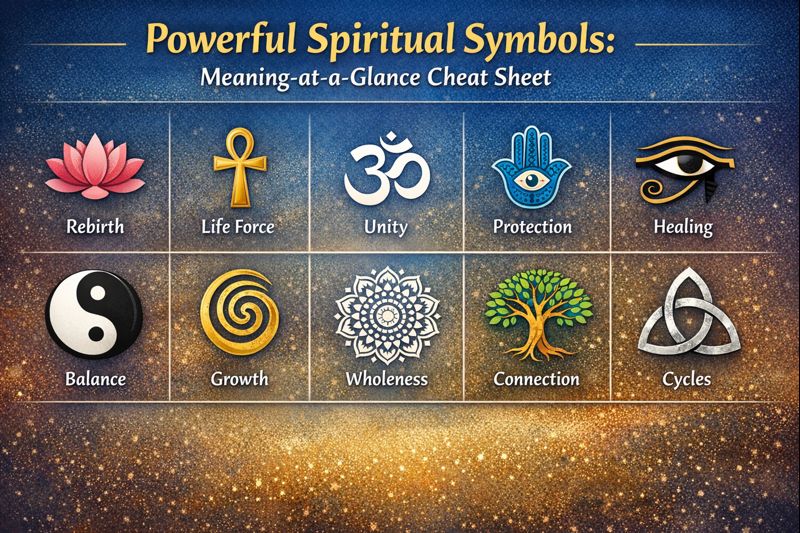
Lotus: Growth Through the Mud
The lotus is one of those ancient spiritual symbols that feels universally relatable. It grows in muddy water, yet blooms clean and bright. Translation? You can come from chaos and still become something beautiful.
When it resonates most: after heartbreak, burnout, grief, big life changes—any time you’re rebuilding.
A simple lotus practice
- Write down one “mud” moment you survived.
- Under it, write one thing it taught you (even if the lesson was tiny).
That’s lotus energy: not denying the mess, but refusing to let the mess define you.
Om (Aum): The Sound That Points Back to Stillness
Om isn’t just a pretty symbol—it represents a sacred sound used in Hindu traditions and beyond. Many people connect it with the feeling of “everything is connected,” like you’re one thread in a massive cosmic fabric.
How to use it respectfully: as a meditation symbol—a reminder to slow down, breathe, and return to presence.
Quick reset (30 seconds)
Inhale slowly… exhale longer than you inhale… and silently think: “Return.”
That’s the real point of Om for everyday life: coming home to yourself.
Ankh: Life Force and Continuity
The ankh—often called the “key of life”—comes from ancient Egypt and symbolizes life, vitality, and continuity. It’s the kind of symbol that whispers, “You’re still here. Keep going.”
Best time to lean on it: when you’re tired, discouraged, or questioning your purpose.
Ankh-style intention
Try: “I protect my life force.”
Then back it up with one practical boundary today—sleep, hydration, saying no, leaving early, muting the group chat. Spirituality works better when it has legs.
Eye of Horus: Protection and Wholeness
The Eye of Horus is a classic protection symbol—often linked to healing, safety, and restoration after loss. It’s not just “ward off bad vibes.” It’s deeper: rebuilding what was broken.
A grounded protection tip
Protection isn’t only crystals and incense. It can also be:
- unfollowing what dysregulates you
- cleaning your space
- keeping your promises to yourself
That’s spiritual protection with receipts.
Hamsa: Boundaries, Blessing, and the “Nope” You Needed
The Hamsa (hand symbol) shows up across multiple cultures and faith traditions, often connected to protection, blessings, and deflecting negativity. It’s basically the spiritual version of a calm, confident “not today.”
Hamsa question
Ask yourself: “Where do I need stronger boundaries to protect my peace?”
Then choose one boundary that’s realistic—not dramatic. Small boundaries, consistently kept, are powerful.
Yin-Yang: Balance Without Perfection
Yin-yang gets misunderstood as “good vs evil.” It’s more like: life is made of complementary forces—rest and action, softness and strength, solitude and connection. Both belong.
If you’re in a “spiritual awakening” season, yin-yang can feel like permission to stop trying to be one thing all the time.
Balance check
Pick one:
- If you’re overloaded → add yin (rest, stillness, quiet).
- If you’re stuck → add yang (movement, decisions, momentum).
Tree of Life: Connection, Roots, and Purpose
The Tree of Life shows up in many traditions because it’s such a clean metaphor: roots (where you come from), trunk (what stabilizes you), branches (what you’re becoming).
A Tree of Life journaling prompt
- Roots: What values raised you (even if your upbringing was hard)?
- Trunk: What keeps you steady now?
- Branches: What are you growing into next?
This is symbolism in spirituality at its best: practical, reflective, and honest.
Mandala: Coming Back to Center
Mandalas often represent wholeness—like a visual map back to your center. That’s why they’re used in sacred geometry practices and meditation traditions: your eyes focus, your breath slows, your nervous system softens.
Try this (no art skills required)
Draw a messy circle. Inside it, add dots, lines, tiny shapes—whatever feels calming.
It’s not about being “good.” It’s about being here.
Spiral: Evolution and the Long Game
The spiral is one of my favorite Powerful Spiritual Symbols because it tells the truth: healing isn’t a straight line. You’ll revisit old lessons—just from a higher level.
So if you ever think, “Why am I back here again?”
The spiral answers: “You’re not back. You’re deeper.”
Spiral mantra
“Same lesson, new strength.”
Say it when you feel like you’re repeating a pattern—but you’re responding better than before.
Celtic Knot (Triquetra): Interconnection and Sacred Cycles
The triquetra (a three-loop knot) often symbolizes interconnectedness and sacred cycles—mind/body/spirit, past/present/future, or the ever-turning rhythm of life.
A simple way to use it
Choose your “three” for this season:
- What I’m releasing
- What I’m learning
- What I’m building
It’s an intention setting framework that doesn’t require perfect clarity—just honest direction.
Black Obsidian: The Shadow-Work Symbol You Don’t Ignore
Black obsidian tends to symbolize truth, grounding, and reflection—especially when you’re ready to face the parts of yourself you usually avoid (fear, old patterns, people-pleasing, denial).
If you want a deeper breakdown, this guide on black obsidian spiritual meaning lays it out in a really practical way.
Use it gently
Black obsidian energy isn’t “more intensity.” It’s more honesty.
Try asking: “What am I pretending isn’t affecting me?”
Then take one supportive action—journal, talk to someone safe, or simply rest. Shadow work works best when you’re kind while you’re brave.
5 Tools to Work With Powerful Spiritual Symbols
Below are beginner-friendly tools with strong buyer intent (clear use cases) and lots of recent positive feedback.
1) The Original Rider Waite Tarot Deck (A.E. Waite / Pamela Colman Smith)
A classic deck packed with symbolism—great for learning archetypes and protection symbols through storytelling.
Features: iconic imagery, beginner-friendly guidebook style system, widely referenced
Best for: beginners, journaling readers, anyone learning “spiritual symbols meaning” through tarot
2) The Wild Unknown Tarot Deck and Guidebook (Kim Krans)
Modern, intuitive art that makes symbols feel emotional and alive (in a good way).
Features: bold animal archetypes, sturdy cards, guidebook included
Best for: intuitive readers, creatives, people who want a less “traditional” vibe
3) CRYSTALYA Protection Crystals and Healing Stones Gift Set (wooden box)
A curated set that’s easy to use for energy cleansing, grounding, and intention setting—without needing to be a crystal expert.
Features: multiple stones, info guide, gift-ready box
Best for: beginners, gift buyers, people building a simple daily ritual
4) JUSTINSTONES Clear Quartz Pendulum
A simple tool often used for yes/no clarity checks—helpful if you’re practicing intuition in a structured way.
Features: clear quartz point, chain, easy handling
Best for: journaling prompts, decision clarity, meditation symbols practice
5) RYVE Mandala Coloring Book for Adults (spiral-bound)
Mandalas are sacred geometry you can feel. Coloring them is a surprisingly effective nervous-system reset.
Features: spiral binding, single-sided pages, mindfulness-friendly layout
Best for: stress relief, evening routines, creative meditation
Research-Backed Insight, FAQs, and a Gentle Conclusion
What research says (and why it matters)
If you’ve ever felt “weirdly calmer” after a small ritual—lighting a candle, repeating a phrase, touching a symbol—research suggests there’s something real happening.
- A CDC/NCHS report using National Health Interview Survey data found meditation use among U.S. adults rose from 4.1% (2012) to 14.2% (2017). That’s a big jump—and it lines up with how many people now use symbols and practices for stress support.
- A major review in JAMA Internal Medicine found meditation programs showed
small-to-moderate improvements in outcomes like anxiety and depression in clinical populations—meaning these practices can be genuinely supportive for many people. You can read the full review here: evidence on mindfulness meditation programs for psychological stress. - And when it comes to rituals specifically, research suggests they can reduce anxiety and improve performance under pressure. Here’s the paper: research on rituals improving performance by decreasing anxiety.
In plain language? Powerful Spiritual Symbols can act like anchors. They don’t “fix” your life overnight—but they can help your mind and body shift into a steadier state where better choices become easier.
FAQs
What are the most Powerful Spiritual Symbols for protection?
Common protection symbols include the Hamsa, Eye of Horus, and certain grounding stones like obsidian. Use one symbol consistently with a clear boundary-setting intention.
How do I choose a spiritual symbol that matches me?
Notice what you’re craving: peace, strength, healing, clarity. Then choose the symbol that reflects that need. The “right” symbol usually feels calming—not forced.
Can I wear spiritual symbols as jewelry every day?
Yes—if you understand the meaning and wear it respectfully. Let it be an anchor: a daily reminder of your intention, not just a fashion statement.
Do spiritual symbols work if I’m not religious?
They can. Symbols often work through focus, meaning, and habit—like a mental cue that shifts your state. If it helps you feel centered, it’s doing something useful.
How can I use Powerful Spiritual Symbols in a daily routine?
Keep it simple: pick one symbol, pair it with one habit (breathwork, journaling, a short prayer/affirmation), and repeat daily for a week. Consistency beats complexity.
Conclusion
If you take nothing else from this: Powerful Spiritual Symbols aren’t about being “mystical enough.” They’re about remembering who you are when life gets loud. Pick one symbol that feels meaningful, learn its story, and let it guide one small action—today.
Small steps, repeated with intention, turn into real transformation. And you deserve that kind of steady magic.