
Spiritual Healer: What They Do, How to Choose One, and What Evidence Says

We may earn a commission for purchases made using our links. Please see our disclosure to learn more.
You may feel drawn to spiritual support because ordinary advice is not touching the deeper question: “What does this experience mean for me?” A spiritual healer may offer ritual, meditation, energy-based practices, prayer, or reflective conversation. Yet the title covers many approaches, and not every practitioner works ethically. This guide explains what spiritual healing can realistically offer, what a session may involve, how it differs from therapy and medical care, and which warning signs matter. You will also find personal-practice tools, research-backed context, and questions that help you choose support without surrendering your judgment, with clearer expectations and fewer costly mistakes.
Affiliate disclosure: This article may contain affiliate recommendations. If you purchase through a qualifying link, the site may earn a commission at no extra cost to you.
What Is a Spiritual Healer?
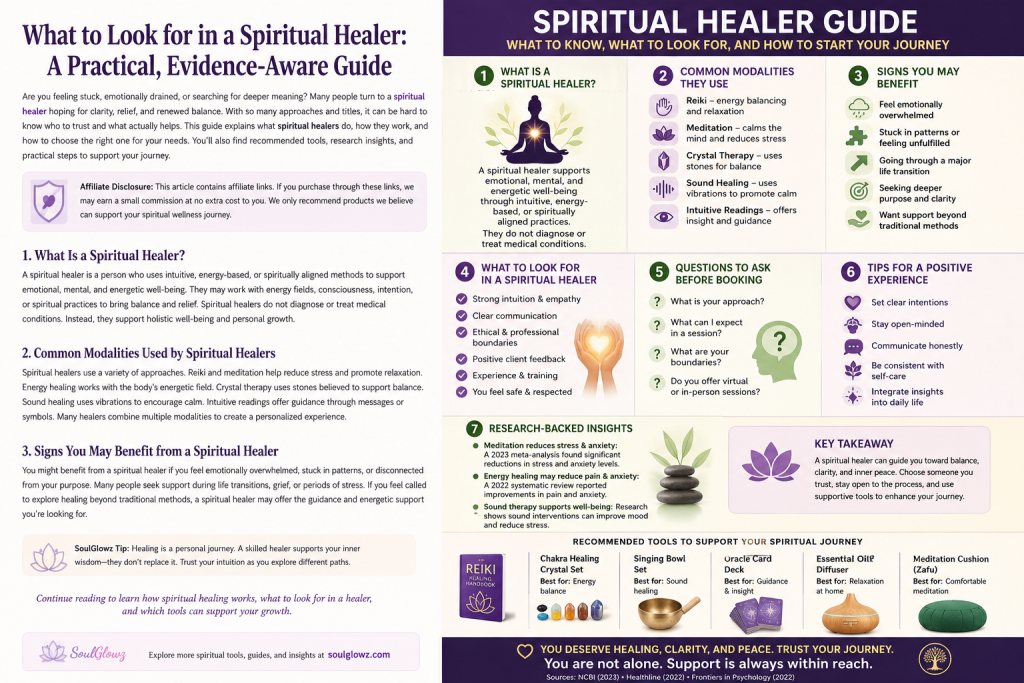
A spiritual healer supports a person’s sense of meaning, connection, balance, or relationship with the sacred. Sessions may involve Reiki, prayer, meditation, sound, visualization, breath awareness, intuitive conversation, or ceremony.
The term is broad rather than standardized. A title alone does not reveal training or ethics. A responsible practitioner explains the method, its limits, and when another professional is better qualified.
What a Spiritual Healer Can—and Cannot—Do
A thoughtful practitioner can offer attentive listening, symbolic ritual, and reflection around grief, change, identity, or purpose. The experience may help you slow down and name feelings that stayed in the background.
However, a spiritual healer should not diagnose illness, promise cures, guarantee outcomes, or claim certainty about your future. Spiritual care may complement treatment, but it should never replace medical or psychological care.
Common Types of Spiritual Healing Practices
Reiki practitioners use light touch or hold their hands above the body. Spiritual directors focus on listening, prayer, discernment, and faith. Sound practitioners may use bowls, bells, or voice. Other approaches include meditation, chakra reflection, breath awareness, intuitive readings, and ceremony.
Traditions carry different meanings. When a practice comes from a specific lineage or Indigenous community, look for respectful training, accurate attribution, and humility—not sacred customs treated as décor.

Why People Seek Spiritual Healing
People often seek a spiritual healer during grief, burnout, illness, relationship change, or a crisis of meaning. They may want a witness, a transition ritual, or quiet space to hear their thoughts.
Your reason should guide your choice. Religious discernment may call for a spiritual director. Trauma may call for a licensed therapist who welcomes spiritual concerns. Others may prefer meditation or reflective conversation.
What Happens During a Typical Session?
A first session usually begins with your goals, spiritual language, touch boundaries, and concerns. The practitioner should explain the method.
The practice might include silence, breathing, prayer, light touch, sound, journaling, or visualization. Afterwards, you may discuss what you noticed. Some people feel relaxed or emotional; others feel little. A trustworthy spiritual healer does not treat every sensation as proof.
How to Choose a Spiritual Healer You Can Trust
Start with fit rather than charisma. Look for clear descriptions, transparent fees, informed consent, realistic claims, and respect for different beliefs. Ask what happens when someone needs medical or mental-health support. Ethical providers refer out.
A consultation can reveal whether you feel heard or managed. If you are still defining the support you want, Soulglowz’s guide to finding your inner compass offers prompts for distinguishing guidance from pressure.
Credentials, Ethics, and Questions to Ask
Training varies, so ask: Who trained you? What happens during a session? How do you protect privacy? What are your touch policies? When do you refer elsewhere?
Also ask whether the spiritual healer follows a code of ethics, belongs to an accountable organization, or carries professional insurance. None guarantees a good fit, but clear answers show professionalism. Mystical claims never replace accountability.

Red Flags That Should Make You Walk Away
Leave if a practitioner uses fear to create dependence. Warning signs include claims that a curse, entity, or blocked chakra will harm you unless you buy more sessions. Avoid guaranteed cures, pressure to stop medication, secrecy, and demands to cut off skeptical loved ones.
Touch without consent, sexualized behavior, humiliation, financial manipulation, and threats are serious breaches. A spiritual healer should strengthen your choices—not claim only they can protect you.
Spiritual Healing, Therapy, and Medical Care
These roles may overlap emotionally, but they are not interchangeable. A licensed therapist addresses mental-health concerns within a regulated scope. A medical professional diagnoses and treats health conditions. A spiritual healer focuses on meaning, ritual, belief, reflection, or energy-based practices.
Many people combine spiritual practices with therapy or medical treatment. Tell clinicians about complementary approaches, especially supplements, fasting, or intensive breathwork. Safety improves when each provider respects their limits.
Research-Backed Evidence: What the Science Actually Says
Evidence depends on the practice, so sweeping claims about “spiritual healing” mislead. The National Center for Complementary and Integrative Health overview of Reiki says Reiki has not been clearly shown effective for any health-related purpose; studies are often inconsistent or low quality, and evidence does not support the proposed energy field. The page was last updated in 2018, so it does not capture every newer study.
Meditation has a larger, though still mixed, research base. NCCIH reports that U.S. adult meditation use rose from 7.5% in 2002 to 17.3% in 2022. Its meditation and mindfulness evidence summary also cites a 2020 review in which about 8% of participants reported negative effects, commonly anxiety or depression.
The American Psychological Association’s discussion of spirituality in therapy supports client-centered attention to spiritual beliefs while acknowledging that spiritual harm can occur.
How to Set a Sensible Budget
Fees vary by location, length, experience, and format. Request the full cost in writing, including deposits, cancellation charges, add-ons, and package terms. Start with one session rather than a long program while emotionally vulnerable.
A spiritual healer should never encourage debt or urgent payment to prevent supernatural harm. Set your limit beforehand. Lower-cost options include community meditation, faith groups, library books, journaling, or peer gatherings.
Recommended Products for Spiritual Healer-Inspired Practice
Products cannot replace skilled care, but a book, journal, cushion, or sound tool can make personal reflection easier to maintain. These options suit different goals and experience levels.
| Product | Best for | Format | Consideration |
| The Reiki Manual | Reiki study | Reference book | Detailed |
| Chakra Healing | Visual beginners | Illustrated guide | Spiritual framework |
| The Five Minute Journal | Busy routines | Guided journal | Repetitive prompts |
| Florensi Meditation Cushion | Seated practice | Cushion | Needs storage |
| Silent Mind Singing Bowl Set | Sound rituals | Bowl set | Technique matters |
| The Untethered Soul Guided Journal | Deep reflection | Guided journal | Framework-specific |
The Reiki Manual: A Training Guide for Reiki Students, Practitioners, and Masters
Best for: Serious Reiki students and aspiring practitioners
Penelope Quest and Kathy Roberts provide a 352-page reference covering Reiki training levels and professional practice. Its breadth suits readers who want material to revisit as their study develops. However, it may feel dense for casual readers, and a manual cannot replace responsible instruction or evidence-based healthcare.
Chakra Healing: A Beginner’s Guide to Self-Healing Techniques that Balance the Chakras
Best for: Visual beginners exploring chakra traditions
Margarita Alcantara’s 190-page guide introduces chakra concepts through illustrations, meditation, yoga, and breathing. Newcomers can sample several rituals without prior knowledge. Still, readers should treat chakras as a spiritual and cultural framework rather than established anatomy or a method for diagnosing symptoms.
Intelligent Change The Five Minute Journal – Original Daily Gratitude Journal for Women & Men – Mindfulness, Happiness & Daily Reflection – Undated Planner – Affirmation Journal – Gifts for Women
Best for: Busy readers who want a brief daily ritual
This undated journal uses structured prompts to make gratitude and reflection easier to repeat. It suits people who dislike blank pages or want a routine lasting a few minutes. The consistent format is the point, although creative writers may find repeated prompts more restrictive than an open notebook.
Florensi Meditation Cushion – Comfortable Floor Pillow – Traditional Tibetan Meditation Pillow with Beautiful Velvet Cover – Large Floor Cushion Seating for Adults – Premium Yoga Buckwheat Bolster
Best for: Home meditators wanting adjustable seated support
An inner pouch lets users add or remove buckwheat hulls to adjust this cushion’s height for floor meditation. Its stable shape and removable cover suit a dedicated home practice corner. Nevertheless, floor sitting does not work for every body, and the cushion requires more storage space than a folded blanket.
Silent Mind Tibetan Singing Bowl Set – Easy to Play & Beginner Friendly Meditation Bowl with Cushion & Mallet | Stress Relief & Mindfulness | Gift-Ready
Best for: Sound-based rituals in small spaces
This compact set includes a singing bowl, padded cushion, and suede-wrapped wooden mallet, giving beginners the essentials for marking the start or end of meditation. It stores more easily than a larger sound setup. Tone and volume depend on technique, and the bowl should support ritual or attention—not be presented as medical treatment.
The Untethered Soul Guided Journal: Practices to Journey Beyond Yourself
Best for: Readers drawn to deep self-inquiry
Michael A. Singer’s journal pairs prompts and exercises with ideas from The Untethered Soul. It suits readers who want more structure than free-writing while exploring awareness, resistance, and inner dialogue. Because it follows Singer’s particular framework, it may feel less useful when his spiritual language or underlying philosophy does not resonate.
How to Prepare for Your First Session
Write one or two intentions, such as “I want space to process grief.” List questions about the method, touch, confidentiality, fees, and what happens if you become uncomfortable.
Wear comfortable clothing and discuss access needs beforehand. Afterwards, avoid forcing an interpretation. Note what felt supportive, unclear, or uncomfortable; that record can help you decide whether this spiritual healer deserves another appointment.
Spiritual Healer FAQs
Is a spiritual healer the same as a therapist?
No. A therapist has formal mental-health training, location-specific licensure or registration requirements, and a defined clinical scope. A spiritual healer usually works with meaning, ritual, belief, meditation, or energy-based practices. Some professionals have both backgrounds, but one title does not imply the other. Choose clinical care when symptoms, safety, trauma, or daily functioning require it.
How do I know whether a spiritual healer is legitimate?
Look for transparent training, clear boundaries, informed consent, realistic claims, written fees, and willingness to refer you to healthcare professionals. Notice whether questions are welcomed or treated as disloyal. Legitimacy does not require sharing the practitioner’s worldview. It requires honesty about the method, limits, privacy practices, and the fact that results cannot be guaranteed.
Can spiritual healing cure illness?
There is no reliable basis for treating spiritual healing as a cure. Some practices may feel calming, meaningful, or supportive, but that experience does not prove that disease has been treated. Continue prescribed care and discuss complementary practices with your clinician. Step back from anyone who promises a cure, discourages medical evaluation, or blames you spiritually when symptoms continue.
What should I pack or wear to a session?
Choose comfortable clothing that allows easy breathing and movement. Bring water, questions, and any accessibility items you need. A notebook can help with reflections afterwards. You do not need special crystals, clothing, or spiritual objects unless you value them. Before attending, clarify whether you will sit, lie down, remove shoes, or receive any form of touch.
Can I practice spiritual healing at home?
You can create a personal practice through meditation, prayer, journaling, gentle breath awareness, meaningful music, or rituals from your tradition. Keep it modest and observe how it affects you. Stop if it increases distress, dissociation, panic, or obsessive behavior, and seek appropriate support. Home practice can encourage reflection, but it should not become self-diagnosis or replace needed care.
Choosing the Right Spiritual Healer for Your Next Step
Choosing a spiritual healer is less about finding the most mystical person and more about finding someone ethical, clear, respectful, and suited to your goals. Name what you want—religious guidance, Reiki, meditation, ritual, or reflective conversation—then check training, consent, fees, boundaries, and willingness to work alongside healthcare professionals.
Readers exploring Reiki may appreciate The Reiki Manual, while those building a brief habit may prefer The Five Minute Journal. Whatever path you choose, keep your judgment and freedom close. The right spiritual healer will not ask you to surrender your authority; they will support grounded choices and encourage other qualified help when it is needed.