
Visualization Techniques to Attract What You Want

We may earn a commission for purchases made using our links. Please see our disclosure to learn more.
Ever try to “think positive” and… your brain immediately responds with a greatest-hits playlist of everything that could go wrong? Same. That’s why Visualization Techniques can feel like a relief—because you’re not forcing fake optimism. You’re giving your mind something specific to work with.
And honestly? Most people don’t struggle with “dreaming.” They struggle with making the dream feel real enough to act on—especially when motivation is low, confidence is shaky, or life is loud.
In this guide, you’ll learn practical, non-cringey visualization methods you can use for goals, confidence, calm, relationships, and daily momentum—without turning your life into a 24/7 vision-board documentary. You’ll also get tools you can buy (if you want), plus research-backed notes to keep it grounded.
Why Visualization Techniques aren’t “wishful thinking”
Let’s clear this up: visualization isn’t magic. It’s mental training.
Think of it like a GPS. If your destination is fuzzy, your decisions get fuzzy too. But when your brain can “see” a clear target, it’s easier to notice opportunities, make choices faster, and stay steady when you’re tempted to quit.
Also, visualization doesn’t replace action—it supports action by:
- clarifying what you actually want
- reducing decision fatigue (“what should I do next?”)
- building familiarity with uncomfortable steps (so you don’t panic-quit)
- creating emotional buy-in (so you keep going)
If you’ve ever practiced a conversation in your head before having it… congrats. You’ve already been doing this.
Your brain loves pictures: the quick science (without the nerd spiral)
Your brain doesn’t only learn by “doing.” It also learns by imagining and rehearsing, especially when the imagery is vivid and structured.
Researchers often describe mental practice/imagery as a way to improve performance and learning—basically, your mind runs reps before your body does. A large meta-analysis review in this area has argued that mental practice can reliably enhance performance, especially when paired with real practice (Toth et al., 2020).
And on the stress side, guided imagery is commonly used as a relaxation skill. A controlled study comparing relaxation methods found guided imagery increased relaxation state compared to a control group (Toussaint et al., 2021).
Translation: if you use Visualization Techniques well, you’re not “pretending.” You’re training attention, emotion, and behavior.
The 60-second setup that makes visualization actually work
Before you visualize anything, do this tiny setup. It’s boring… and it’s the reason it works.
1) Name your target (one sentence)
Not “I want a better life.” Too big. Try:
- “I want to wake up with less dread.”
- “I want to finish my portfolio by March.”
- “I want to feel calm speaking up in meetings.”
2) Choose the time horizon
Pick one:
- Today (micro-goal)
- This month (habit + results)
- This year (identity + direction)
3) Pick a feeling
Your brain follows emotion like a dog follows snacks.
Choose one feeling you want to practice:
steady, safe, proud, focused, connected, confident.
Now you’re ready.

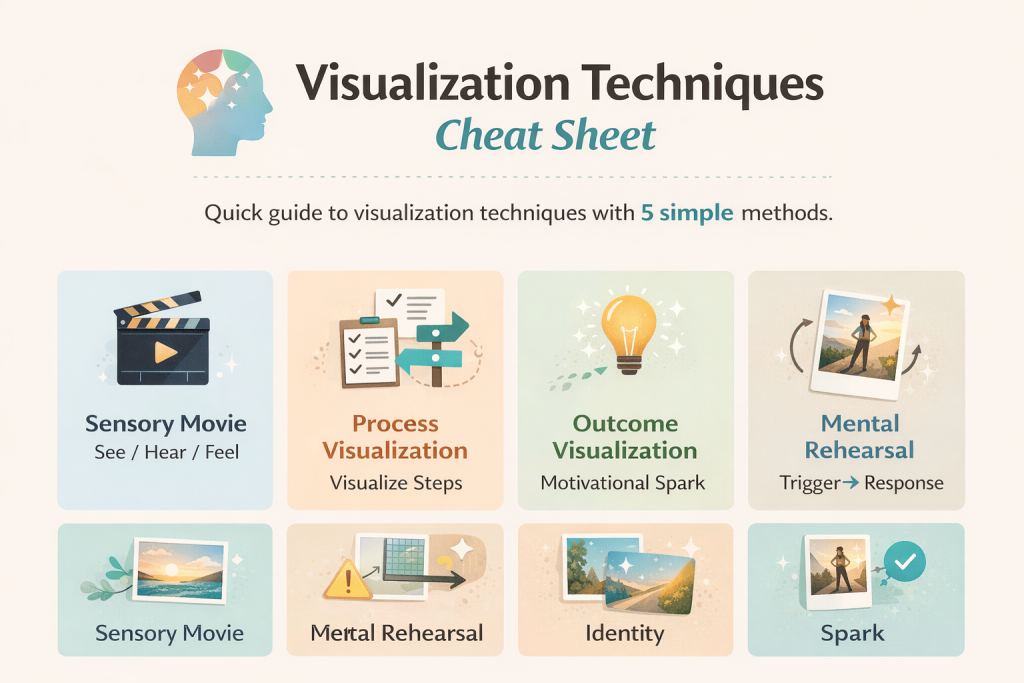
Technique #1: The Sensory Movie Method (your brain’s favorite format)
This is the “I’m watching my future like a short film” approach.
How to do it
Close your eyes and run a 30–60 second scene where you’re already in the outcome.
Add 3 sensory details:
- What do you see? (lighting, colors, setting)
- What do you hear? (tone of voices, background sound)
- What do you feel in your body? (shoulders relaxed? heartbeat steady?)
Example:
You’re finishing a project. You feel your shoulders drop. You hear the quiet click of “Submit.” You see the screen confirm it’s done. You exhale like you’ve been holding your breath for a week.
Tip: Keep it short. A tight scene beats a 10-minute fantasy montage every time.
Technique #2: Process Visualization (the “how” that builds real confidence)
If outcome visualization is the destination, process visualization is the route.
This is the secret sauce for people who say: “I visualize, but nothing changes.”
What to visualize
Instead of the big win, visualize the steps:
- opening the laptop
- starting even when you don’t feel ready
- doing the awkward first draft
- handling distractions
- finishing the next small milestone
Why it works: It trains your brain to see yourself as someone who follows through, not just someone who hopes.
Mini prompt:
“What does Future Me do in the first 10 minutes?”
Technique #3: Outcome Visualization (use it like a spark, not a crutch)
Outcome visualization is powerful… as long as it doesn’t turn into “mental Netflix.”
Use it best when:
- you’re starting something hard
- you need emotional fuel
- you want to remember why you’re doing this
Keep it grounded with one question:
“What would I do today if I genuinely believed this was possible?”
That’s the bridge between imagination and action.
Technique #4: Mental Rehearsal for tough moments (aka: pre-deciding your response)
This one is a confidence cheat code.
Pick a moment that usually throws you off:
- a craving
- a stressful meeting
- a social situation
- a tough conversation
- the “I want to quit” feeling
Now visualize:
- the trigger happening
- your body reaction (yes, include the nerves)
- your calm response (your words, posture, breath)
- the moment passing
It’s like a fire drill for your brain—so when the real thing happens, you’re not inventing a response under pressure.

Technique #5: The “Future Self” snapshot (identity-based visualization)
Some goals don’t fail because you don’t want them. They fail because they don’t match how you see yourself.
So we shift the image: not just what you do, but who you are.
Try this
Picture yourself 6 months from now, living your “normal day”:
- What time do you wake up?
- What’s the first thing you do?
- What do you say “no” to easily now?
- What do you protect like it’s sacred?
Then ask:
“What would that version of me do today?”
It’s gentle. It’s powerful. And it’s way less stressful than trying to “reinvent your whole life” overnight.
Technique #6: Creative visualization with a “scene + symbol”
This is where visualization can feel spiritual without getting floaty.
You pick:
- one scene (your goal in motion)
- one symbol (a physical reminder that anchors the feeling)
Symbol examples: a ring, a sticky note, a screensaver, a stone, a bracelet.
The point isn’t superstition. The point is attention training.
You’re basically telling your brain: “When you see this, remember who we’re becoming.”
Technique #7: Guided imagery + breath (the fastest calm-down combo)
If your brain is loud, guided visualization helps because you’re following a track instead of fighting your thoughts.
Simple version
- Inhale 4 seconds
- Exhale 6 seconds
- On exhale, imagine your body softening (jaw, shoulders, belly)
Then picture a place that feels safe:
- a childhood home
- a beach
- a quiet library
- a mountain road
- your bed on a rainy day
This isn’t about escaping reality. It’s about regulating so you can return to reality with more control.
Technique #8: The “Safe Place” visualization for anxiety and sleep
When anxiety shows up, your mind time-travels to worst-case scenarios like it’s getting paid for it.
So you give it a new job.
Use this script
- “I’m safe right now.”
- “My only job is to rest.”
- “Tomorrow gets my effort. Tonight gets my calm.”
Then visualize:
- dim lighting
- heavy blanket feeling
- slow breathing
- a calm scene playing like a loop
If sleep is hard for you, keep the scene boringly predictable. Your brain loves predictable when it’s trying to power down.
Technique #9: Visualization Techniques for relationships (repair, boundaries, confidence)
Relationships are a huge visualization blind spot because we focus on the other person—when the power is in your response.
Visualize this instead:
- you staying calm while speaking honestly
- you pausing before reacting
- you holding a boundary without over-explaining
- you leaving a conversation feeling proud of how you showed up
Try this line in your scene:
“I’m allowed to be kind and clear.”
That combo changes everything.
Technique #10: Career and money visualization (make it practical)
Money goals get weird fast. People either avoid them or obsess over them.
So keep it grounded: visualize behavior, not just numbers.
Examples to visualize
- checking your budget without dread
- sending the email you’ve been avoiding
- finishing a portfolio piece
- negotiating calmly
- tracking expenses weekly
Then add one outcome image:
your bank app, your paid invoice, your calm face when rent is due.
Your brain needs proof that “this is the new normal.”
The most common mistakes (and how to fix them fast)
Mistake 1: Being vague
Fix: make it a scene, not a concept.
Mistake 2: Skipping emotion
Fix: pick one feeling and practice it like a skill.
Mistake 3: Only visualizing wins
Fix: rehearse obstacles + your response.
Mistake 4: Expecting instant transformation
Fix: treat it like brushing your teeth. Small, daily, not dramatic.
Mistake 5: Using visualization to avoid action
Fix: end every session with:
“What’s one small step I’ll take today?”
Product Section: Tools that make visualization easier
Affiliate disclosure: As an Amazon Associate, I may earn from qualifying purchases.
Below are five practical tools that support Visualization Techniques in the real world—meaning: less “I’ll do it later,” more “I did it today.”
1) ZICOTO Inspirational Vision Board Book (clip-art style vision board kit)
Short description: A ready-to-use vision board book with images, quotes, and words—great if you hate cutting magazines.
Features: curated visuals; simple format; quick goal themes (career, wellness, relationships).
Use cases (who it’s for): beginners, visual learners, busy people who want a “plug-and-play” vision board.
2) Intelligent Change: The Five Minute Journal (gratitude + intention)
Short description: A structured daily journal that pairs perfectly with visualization because it builds consistent focus and reflection.
Features: guided prompts; quick daily routine; easy to stick with.
Use cases: anyone who wants consistency, mindset support, and a simple daily anchor.
3) InnoGear Essential Oil Diffuser (aromatherapy + mood cue)
Short description: A diffuser that can become your “visualization trigger”—same scent, same ritual, same calm signal.
Features: ultrasonic cool mist; auto shut-off; ambient light modes (varies by model).
Use cases: people who want a relaxing atmosphere for guided imagery, breathwork, or nightly wind-down.
4) Intelligent Change Mindful Focus Hourglass (visual timer for focus)
Short description: A minimal hourglass timer that helps you commit to short visualization or rehearsal sessions without checking your phone.
Features: screen-free timing; simple ritual; good for Pomodoro-style focus.
Use cases: overthinkers, phone-scrollers, and anyone building a 5–10 minute daily practice.
5) Your Personal Vision Book (clip art + collage images)
Short description: A collage-style vision book with lots of images—helpful for building goal clarity fast.
Features: themed imagery; easy cutting; good for multi-goal boards (home, health, travel, career).
Use cases: creatives, planners, and people who want a more “life design” vibe.
What the research says (quick + useful)
- A major meta-analysis review argues that mental practice can improve performance, especially when combined with actual practice (Toth et al., 2020).
- A controlled relaxation study found guided imagery increased relaxation state compared to a control group (Toussaint et al., 2021).
If you want a deeper read, here are two solid sources (linked with descriptive anchor text, so you know what you’re clicking):
And if you like adding a symbolic “anchor” to your practice (totally optional, but meaningful for many people), here’s a helpful resource on moonstone significance for intuition and intention setting.
FAQs
What are the best Visualization Techniques for beginners?
Start with Sensory Movie Method (30–60 seconds) and Process Visualization (first 10 minutes of action). Keep it short and repeat daily.
How long should I visualize each day to see results?
Aim for 3–10 minutes. Consistency beats intensity. If you can do 60 seconds daily, you’re already building the habit and the mental “pathway.”
Can visualization reduce anxiety or help with sleep?
Yes—especially guided imagery and safe place visualization, which are commonly used for relaxation and stress reduction (Toussaint et al., 2021).
Should I visualize the outcome or the process?
Both—but prioritize process if you want follow-through. Use outcome visualization as motivation, then rehearse the steps that get you there.
Why do I feel emotional when I visualize?
Because vivid imagery can activate real feelings—hope, grief, fear, excitement. That’s normal. If it feels intense, soften the scene, shorten the time, and anchor with slow breathing.
Conclusion
If you take nothing else from this: Visualization Techniques work best when they’re specific, emotional, and connected to a next step. You’re not “trying to trick the universe.” You’re training your attention, your nervous system, and your identity to match the life you want.
So pick one technique. Try it for 5 minutes today. Then do one tiny action that matches the picture you just practiced.
You don’t need perfect belief. You just need a clear direction—and a willingness to show up.