
How to Read a Rider Waite Tarot Deck

We may earn a commission for purchases made using our links. Please see our disclosure to learn more.
You open a tarot deck, pull a card, stare at a tiny cliff, a dog, and a cheerful person in tights, and suddenly your brain goes blank. Very normal. A lot of people buy a rider waite tarot deck because it feels classic and approachable, then freeze the second they try to actually read it.
The good news is that this deck is one of the easiest places to begin. It gives you stories, symbols, facial expressions, colors, and everyday scenes you can actually work with. You do not need to be born “gifted.” You do not need to memorize 78 meanings in one dramatic candlelit weekend.
This guide will help you understand the structure of the deck, read cards without panic, build confidence with simple spreads, and create a practice that feels grounded instead of performative.
Affiliate note: If you choose to buy any recommended tools later, I may earn a small commission at no extra cost to you.
Why the Rider Waite Tarot Deck Is Still the Go-To Beginner Deck
There is a reason this deck keeps showing up in beginner guides, reader toolkits, and gift lists. The Rider-Waite-Smith tradition is rooted in Pamela Colman Smith’s 1909 artwork, and its imagery became a reference point for many modern tarot decks that followed.
More importantly, it is readable.
You are not looking at abstract marks and hoping for enlightenment to arrive by express delivery. You are looking at full scenes. That means the cards give you emotional cues right away. Even before you know textbook meanings, you can ask:
- What is happening here?
- Who looks calm?
- Who looks stuck?
- What feels obvious?
- What feels hidden?
That alone can get a reading moving.
A Quick History of the Rider Waite Tarot Deck
The deck most people call the Rider-Waite deck was first published in 1909. Arthur Edward Waite developed the deck’s symbolic framework, while Pamela Colman Smith brought it to life through the illustrations. Many readers now prefer the name Rider-Waite-Smith or Smith-Waite to give fuller credit to Smith’s creative role.
That name shift matters.
It reminds you that tarot is not only about meanings. It is also about images, storytelling, and visual intuition. Smith’s illustrations are a huge reason the deck remains so useful for beginners.
Why This Deck Feels More Beginner-Friendly
A standard Rider-Waite deck contains 78 cards altogether, with 22 in the Major Arcana and 56 in the Minor Arcana. The major cards track big themes and turning points, while the minor cards deal more with everyday life, habits, emotions, work, and relationships.
It also helps that the Minor Arcana are fully illustrated in the Rider-Waite tradition, instead of showing only suit symbols. That means even cards like the Five of Pentacles or Eight of Cups tell a little story on the card itself.
Think of it like the difference between reading a recipe title and seeing a photo of the meal. One gives you data. The other gives you a feeling.
Major Arcana: The Big Life Lessons
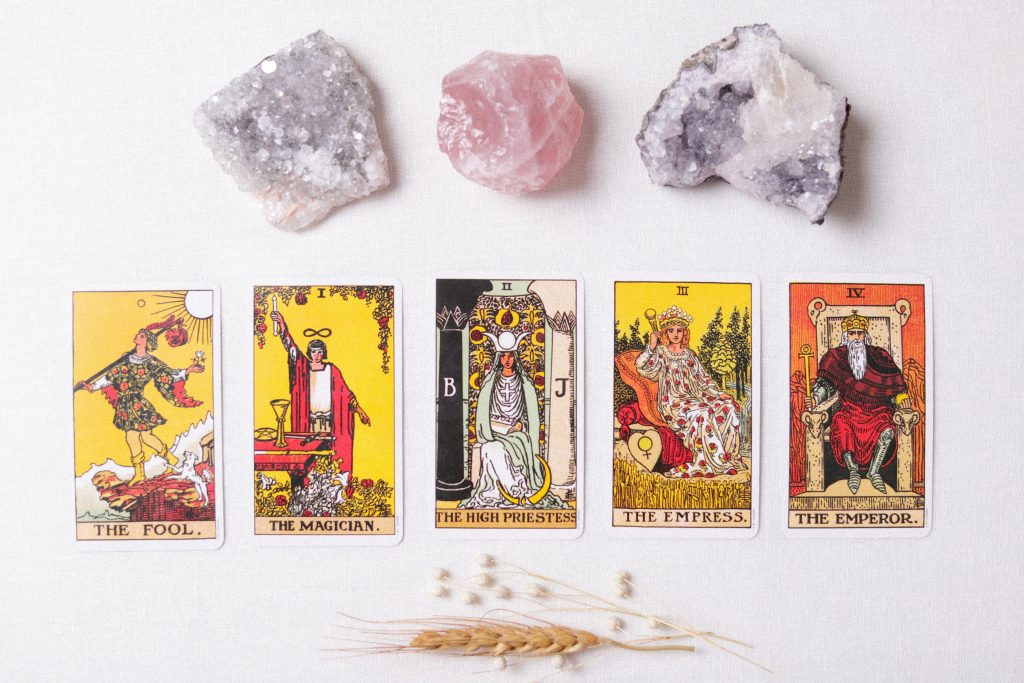
The Major Arcana are the cards people tend to remember first: The Fool, The Lovers, Death, The Star, The Sun, and so on. These cards usually point to major lessons, soul-level shifts, identity changes, and bigger seasons of life.
A simple way to read them:
- The Fool often suggests a beginning
- The Hermit often suggests reflection
- Death usually points to transformation, not literal doom
- The Tower often points to disruption or truth arriving fast
- The Star often brings hope, healing, or renewal
You do not need to make them spooky. Big does not always mean scary. Sometimes a Major Arcana card simply says, “Hey, pay attention. This matters.”
Minor Arcana: The Everyday Storyline
If the Major Arcana are the movie trailer, the Minor Arcana are the actual weekly episodes.
The four suits usually read like this:
- Cups: feelings, relationships, intuition
- Swords: thoughts, conflict, truth, decisions
- Wands: energy, creativity, ambition, momentum
- Pentacles: work, money, health, home, practical life
Once you understand the suits, the deck gets much less intimidating. You stop seeing 56 random cards and start seeing patterns.
For example, a lot of Cups together may suggest emotional processing. Too many Swords may hint at stress, mental loops, or hard conversations. It is not magic theater. It is pattern recognition with symbolism.
Start With Symbols Before You Memorize Meanings
This is where beginners often make things harder than they need to be.
Before grabbing the guidebook, look at the card and ask what you notice first. In the Rider-Waite tarot deck, symbols do a lot of the heavy lifting. Water may point to emotion. Mountains may suggest challenge. Gardens can imply growth. Grey skies can shift the mood. Body language matters too.
Try this tiny exercise:
- Pull one card.
- Describe it like you are explaining it to a friend.
- Name three emotions it gives off.
- Then check the traditional meaning.
That order matters. It trains your intuition without cutting you off from structure.
A Simple Three-Card Spread You Will Actually Use
You do not need a 12-card spread with six clarifiers and a dramatic soundtrack.
Start with this:
Past, Present, Next Step
- Card 1: What shaped this situation
- Card 2: What is happening now
- Card 3: What energy supports the next step
This spread works for relationships, work decisions, spiritual reflection, creative blocks, and those “why do I suddenly feel weird about everything?” seasons.
Keep your question open enough to allow insight, but specific enough to stay useful.
Good example:
“What energy surrounds my current job situation?”
Less helpful example:
“Will everything in my life be perfect by Friday?”
How to Ask Tarot Questions That Lead to Clearer Guidance
The way you phrase the question often influences the reading more than the shuffle itself.
Ask questions that invite reflection:
- What am I missing here?
- What energy do I need to understand?
- What lesson is showing up for me?
- What would help me move forward with clarity?
- Where am I holding too tightly?
Questions like these keep the reading grounded. They also stop you from turning tarot into a yes-or-no spiral machine.
Tarot tends to work best as a conversation, not a courtroom verdict.
How to Read Intuitively Without Doubting Yourself Every Five Seconds
Intuition is not always a thunderbolt. Sometimes it is just the first honest thing you notice.
Maybe you pull the Six of Swords and instantly think, “This feels like emotional distance.” Great. That is a valid starting point. Then you compare it with the traditional meaning and refine it.
A balanced reading usually has three parts:
- the image
- the traditional meaning
- your present context
That blend is where real confidence grows.
You are not trying to become dramatic. You are trying to become observant.
Upright and Reversed Cards Explained
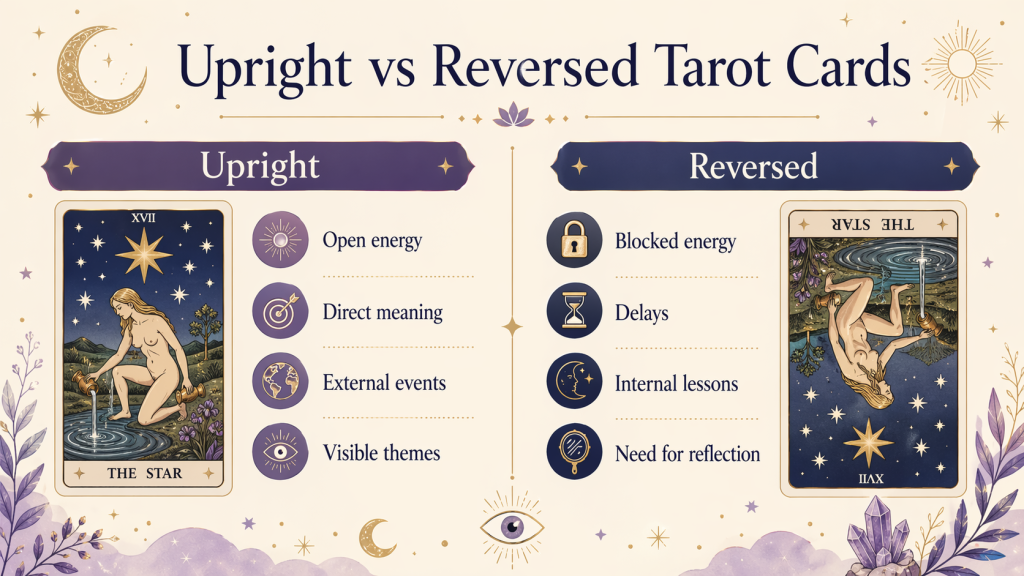
Reversed cards are simply cards that appear upside down.
Some readers use them. Some do not. Both approaches are fine.
If you do use reversals, do not treat them like automatic bad news. A reversed card can suggest:
- blocked energy
- internal energy
- delay
- avoidance
- the need to revisit the lesson
For example, an upright Ace of Cups may feel like emotional openness. Reversed, it might point to emotional overflow, guardedness, or difficulty receiving.
If reversals overwhelm you, skip them for now. Learning tarot is not a suffering contest.
A Gentle Tarot Routine You Can Actually Stick To
Consistency beats intensity here.
A simple practice might look like this:
Daily Pull
One card each morning. Write what you notice. Revisit it at night.
Weekly Check-In
Pull three cards every Sunday and ask what energy is moving through the week.
Monthly Reflection
Pull one card for what to release, one for what to welcome, and one for what to trust.
This is also where journaling helps a lot. Over time, you start noticing your own symbolic language. That is when tarot becomes less like a script and more like a relationship.
Common Mistakes New Readers Make
Almost everyone does at least three of these. Sometimes before breakfast.
- Reading while panicking
- Asking the same question five different ways
- Treating “scary” cards as punishment
- Ignoring the image and jumping straight to keywords
- Pulling endless clarifiers until the message gets muddy
A better approach is slower and kinder. Pull fewer cards. Sit with them longer. Let the first reading breathe before demanding a sequel.
5 Tools That Can Support Your Practice
1) The Rider Tarot Deck®: The Authentic Rider-Waite® Tarot Deck with Instruction Booklet
Short description: A classic starting point if you want the standard version most beginner resources reference.
Features: Instruction booklet, traditional imagery, beginner-friendly formatting.
Who it’s for: First-time readers who want the most recognizable deck for learning card meanings and spreads.
2) The Original Rider-Waite® Tarot Set
Short description: A fuller set for readers who want the deck plus extra study help.
Features: It comes with a Celtic Cross spread guide plus a revised edition of The Pictorial Key to the Tarot.
Who it’s for: Beginners who like having a little more historical and interpretive support right in the box.
3) Pocket Rider-Waite Tarot
Short description: A travel-friendly version of the classic deck.
Features: Compact format, instruction booklet, upright and reversed meanings, introduction by Stuart R. Kaplan.
Who it’s for: Readers who want to carry tarot in a bag, keep a deck on a desk, or practice on the go.
4) The Ultimate Guide to the Rider Waite Tarot
Short description: A deeper study companion focused on card symbolism.
Features: Explains ten major symbols on each card and includes extensive illustrations.
Who it’s for: Visual learners who want to move beyond basic keywords and really understand what the images are doing.
5) Llewellyn’s Complete Book of the Rider-Waite-Smith Tarot
Short description: A more expansive guidebook for long-term study.
Features: Covers the deck’s creation story, analyzes all 78 cards, and includes 78 spreads.
Who it’s for: Readers who know they are going to stick with tarot and want one reference book they can keep returning to.
What Research and Experts Say About Reflective Rituals
Tarot itself is not a clinical treatment, and it should not replace mental health care. Still, some of the habits people pair with tarot, like mindfulness and journaling, do have meaningful support in research.
A mindfulness review relevant to calm Rider Waite tarot deck rituals from NCCIH says meditation and mindfulness practices may help people improve quality of life and may help with stress, anxiety, and sleep in some contexts, while also noting that evidence quality varies and should not be overhyped.
An expressive writing review that supports Rider Waite tarot deck journaling habits found that writing about stressful or emotional experiences for short sessions over several days was often linked with better psychological and physical outcomes than writing about neutral topics.
So no, the cards are not a substitute for therapy. But a grounded tarot practice can absolutely become a thoughtful framework for reflection, self-observation, and emotional honesty.
How to Blend Tarot With Other Spiritual Tools
Your practice does not have to look like anyone else’s.
Some people pair tarot with breathwork. Some light a candle. Some use prayer. Some pull a card and then go for a walk because their best spiritual insights arrive in sneakers, not incense clouds.
If you like visual ritual, you might also enjoy pairing your readings with crystal grid layouts for beginners. It can add intention and structure without making your practice feel complicated.
The point is not to collect spiritual accessories like trophies. The point is to find a rhythm that helps you listen more honestly.
FAQs About the Rider Waite Tarot Deck
Is the rider waite tarot deck good for complete beginners?
Yes. It is one of the best beginner decks because the imagery is clear, the card scenes are widely taught, and many books and guides are built around it.
How do I start reading a rider waite tarot deck without memorizing all 78 cards?
Start with one-card pulls, learn the suits, and describe the image before checking the guidebook. That gives you both intuition and structure.
Should I read reversed cards in a rider waite tarot deck?
You can, but you do not have to. A lot of beginners begin by reading only upright cards and bring in reversals later, once they feel more comfortable.
How often should I practice with my tarot deck?
A simple daily or weekly practice works well. Even one card a day is enough to build familiarity over time.
Can I use a rider waite tarot deck for self-reflection instead of prediction?
Absolutely. Many readers use tarot mainly for insight, journaling, emotional check-ins, and decision support rather than fortune-telling.
Conclusion
Learning the rider waite tarot deck is less about memorizing a secret code and more about building a relationship with symbols, stories, and your own honest attention.
Start small. Read simply. Let the cards speak before the internet does. Trust what you notice, then test it against tradition. That is how confidence grows.
You do not need to become a perfect reader overnight. You just need to keep showing up, one card at a time.