
Spiritual Growth: A Practical Guide to More Awareness, Meaning, and Purpose

We may earn a commission for purchases made using our links. Please see our disclosure to learn more.
Spiritual growth can be hard to define. You may want a deeper sense of meaning, a steadier inner life, or a stronger connection to your values, yet still wonder what you are actually supposed to do. The answer does not require one belief system or an elaborate ritual. Spiritual growth can begin with small practices that help you notice yourself more clearly, respond with greater intention, and make room for reflection.
This guide explains what inner growth can look like in everyday life, which habits may support it, what research says about mindfulness and compassion, and how to choose a few useful tools without turning the process into another shopping project.
Affiliate disclosure: Some products mentioned in this guide may earn us a commission if you make a purchase, at no additional cost to you.
What Spiritual Growth Really Means
Spiritual growth is the gradual development of awareness, meaning, values, compassion, and connection beyond immediate wants or reactions. For one person, that connection may be religious. For another, it may come through nature, service, meditation, creativity, or a personal philosophy.
The useful question is not whether your practice looks “spiritual enough.” It is whether it helps you live with more honesty, attention, and alignment.
Signs You May Be Growing Spiritually
Growth is often quieter than expected. You may recover from conflict more thoughtfully, question old assumptions, or tolerate uncertainty better.
Another sign is self-awareness without constant self-judgment. Growth does not mean staying calm all the time. It can mean noticing anger, fear, or grief sooner and choosing your response instead of reacting automatically.

Start With Values, Not a Perfect Routine
Before adding practices, identify what you want them to serve. Choose three values—perhaps compassion, courage, honesty, patience, faith, or service—and ask how each could appear in ordinary behavior.
A sincere apology may matter more than an impressive routine that never changes how you treat people. Let your values filter which practices deserve your time.
Build a Daily Practice You Can Actually Keep
Consistency usually matters more than complexity. Pick one small action: five minutes of quiet, one journal page, a short prayer, or a mindful walk.
Connect it to a habit that is already part of your routine. If mornings are chaotic, do not force a sunrise ritual because it looks ideal online. A sustainable practice should support your life, not become another guilt-producing checklist.
Use Meditation to Train Attention
Meditation creates space to observe thoughts, emotions, and bodily sensations without immediately reacting. Start with a few minutes and use the breath, a phrase, sound, or open awareness as your anchor.
If you are unsure what fits your temperament, Soulglowz’s guide to different types of meditation explains eight approaches without treating one as universally best. Choose a method you can return to even on distracted days.
Journal to Notice Patterns and Meaning
A journal gives your inner life somewhere to become visible. Ask, “What am I avoiding?”, “What gave me energy today?”, or “Where did my actions match my values?”
Older entries can reveal recurring fears and choices. However, journaling should create insight rather than endless self-analysis. If you keep circling the same thought, pause and return to something concrete, such as movement, conversation, or rest.

Practice Gratitude Without Forcing Positivity
Gratitude works best when it is specific. Name the friend who checked in, the quiet cup of tea, or a small moment of relief.
It also does not require denying pain. You can appreciate one good thing and still be angry, grieving, or uncertain. That balance keeps gratitude honest instead of turning it into a way to avoid difficult emotions.
Make Compassion Part of the Work
A spiritual practice that never reaches other people can become overly inward-looking. Compassion may mean listening fully, setting a boundary without cruelty, helping privately, or admitting when you were wrong.
Self-compassion belongs here too. It is easier to learn from a mistake when you can face it clearly instead of collapsing into shame. Aim for accountability with enough kindness to keep learning.
Create Space for Silence, Nature, and Reflection
Not every meaningful practice needs instructions. A walk without headphones, tending plants, or sitting quietly after a busy day can create space that constant input removes.
Leave small gaps in your schedule unfilled. Silence may feel uncomfortable because it exposes thoughts you normally outrun. That discomfort may simply show how rarely your attention gets to settle.
Research-Backed Practices for Spiritual Growth
Scientific research cannot measure every spiritual belief or experience, but it can study practices commonly included in spiritual routines. A 2026 Nature Human Behaviour network meta-analysis reviewed 183 randomized controlled trials involving 22,811 adults. Mindfulness, compassion-based approaches, positive psychology, yoga, and exercise generally improved well-being compared with inactive controls. However, the researchers reported moderate-to-high risk of bias in many studies and possible publication bias, so these findings do not make any practice a universal cure.
A 2026 systematic review and meta-analysis published in Healthcare examined 30 randomized or quasi-experimental studies involving more than 24,000 participants. The researchers reported an overall Hedges’ g of -0.45 for psychological outcomes, indicating a moderate improvement, with some additional benefit when gratitude practices were incorporated into mindfulness-based interventions.
Evidence for compassion meditation is promising but less certain. A 2022 systematic review and meta-analysis of loving-kindness and compassion meditation found improved life satisfaction across the broader study set, but the effect was not statistically significant when analysis was restricted to randomized controlled trials. These practices can be reasonable supports for spiritual growth, but they should remain flexible and should not replace professional care when you need it.
Recommended Products for Spiritual Growth
Products are optional; none creates spiritual growth by itself. Still, the right tool can reduce friction, provide a cue, or make reflection easier to maintain. These five options serve different preferences.
| Product | Best for | Verified feature | Consideration |
| The Five Minute Journal | Guided reflection | Undated gratitude and reflection prompts | Structured format |
| The Untethered Soul | Contemplative reading | Paperback by Michael A. Singer | Philosophical, not step-by-step |
| Retrospec Sedona Cushion | Seated meditation | Adjustable buckwheat fill; washable cotton cover | Requires floor space |
| Affirmators! Original | Quick reflection prompts | 50-card affirmation deck | Better as a prompt than a full practice |
| Silent Mind Singing Bowl Set | Creating a ritual cue | Bowl, cushion, and mallet included | Sound may not suit shared spaces |
Intelligent Change The Five Minute Journal – Original Daily Gratitude Journal for Women & Men – Mindfulness, Happiness & Daily Reflection – Undated Planner – Affirmation Journal – Gifts for Women
Best for: People who want structured daily reflection
This undated journal uses short gratitude, affirmation, and reflection prompts, which can help someone who wants guidance without writing several pages. Its compact format lowers the barrier to starting. The trade-off is structure: people who prefer open-ended writing may find a blank notebook more natural.
The Untethered Soul: The Journey Beyond Yourself
Best for: Readers who learn through contemplative books
Michael A. Singer’s paperback explores awareness, inner dialogue, and people’s relationship with their thoughts. It suits readers who like pausing over ideas and reflecting between chapters. Because it is philosophical rather than a workbook, someone seeking a clearly sequenced daily program may prefer a more structured resource.
Retrospec Sedona Meditation Cushion, Buckwheat Pillow, Meditation Pillow | Floor Pillow, Yoga Pillow, Crescent Shape, Hip and Leg Support, Cotton Cover, Machine Washable, Adjustable Firmness, Handle
Best for: Home meditators who want adjustable seated support
This crescent cushion uses buckwheat hull filling that can be added or removed to change firmness, and its cotton cover is machine washable. That adjustability is practical when floor-sitting comfort varies. However, a dedicated cushion is unnecessary if a chair, bench, or folded blanket already supports you comfortably.
Affirmators! Original: 50 Affirmation Cards Deck For You Help Yourself without The Self-Helpy-Ness (50 Cards)
Best for: People who like brief, playful reflection prompts
This deck contains 50 affirmation cards plus an instruction card, offering a quick prompt for journaling or a morning pause. Its playful tone may appeal to readers who dislike solemn spiritual tools. Treat the cards as conversation starters with yourself, not promises that repeating a statement will create change.
Silent Mind Tibetan Singing Bowl Set – Easy to Play & Beginner Friendly Meditation Bowl with Cushion & Mallet | Stress Relief & Mindfulness | Gift-Ready
Best for: Anyone who wants a sensory cue for meditation
The set includes a singing bowl, cushion, and mallet, so it can mark the beginning or end of meditation with a consistent sound cue. That can separate a home ritual from the rest of the day. In shared housing, however, consider whether an audible practice will disturb other people.
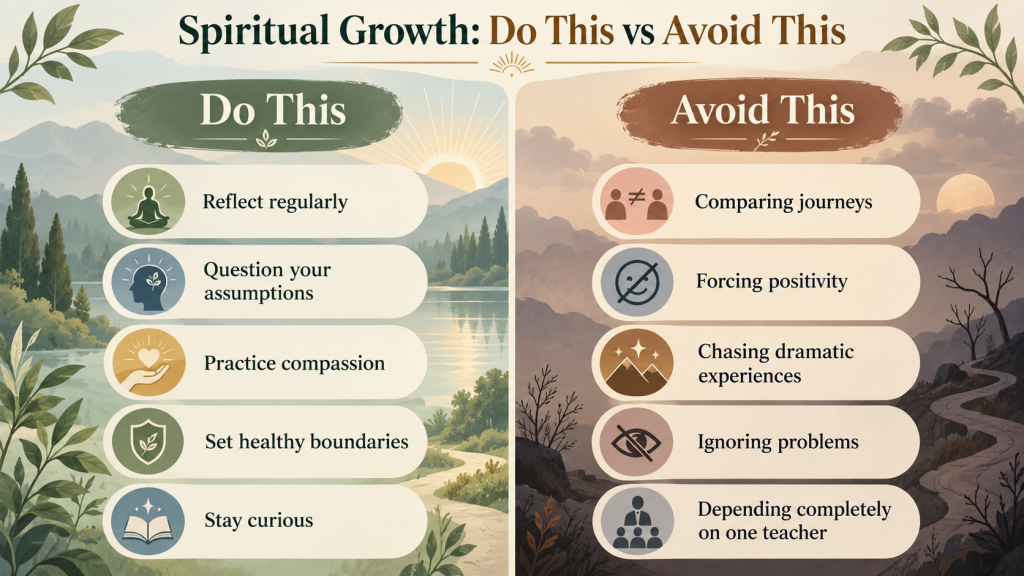
What Can Slow Inner Growth Down
One obstacle is turning spirituality into a performance. Comparing routines or chasing dramatic experiences can pull attention away from ordinary behavior.
Another is using spirituality to bypass real problems. Meditation cannot make a harmful relationship healthy, and gratitude does not erase grief. Be cautious of teachers or communities that discourage questions, demand obedience, promise guaranteed outcomes, or frame setbacks as failures of belief. Healthy growth leaves room for judgment and boundaries.
How to Know a Practice Is Helping
Check the effects outside the practice itself. After a few weeks, ask whether you notice more patience, clearer boundaries, better awareness of your reactions, or stronger alignment between your values and choices.
Also notice the costs. If a practice makes you increasingly fearful, isolated, financially pressured, or dependent on one authority figure, reconsider it. Spiritual growth should not require surrendering critical thinking. Keep what helps you become more present and responsible; revise what does not.
Frequently Asked Questions About Spiritual Growth
What is the best way to begin spiritual growth as a complete beginner?
Start with one practice that takes five to ten minutes, such as quiet breathing, journaling, prayer, or a reflective walk. Pair it with one value you want to live more consistently. After two weeks, review what changed in your attention or behavior before adding anything else. A small repeatable practice is easier to learn from than a complicated routine.
Does spiritual growth require religion?
No. Spiritual growth can happen within a religious tradition, but it can also center on meaning, values, compassion, nature, service, contemplation, or connection. Choose practices that fit your worldview rather than borrowing beliefs you do not genuinely hold. Respectful curiosity is useful; pretending certainty is not required.
How long does spiritual growth take?
There is no fixed timeline because spiritual growth is not a course with a finish date. Some insights arrive quickly, while changes in habits, reactions, and relationships can take much longer. Instead of measuring progress by milestones, look for gradual shifts in awareness, choices, compassion, and alignment with your values. Periodic reflection can make quieter changes easier to notice.
Can meditation cause spiritual growth by itself?
Meditation can support awareness, but it is not the whole process. What matters is how insight influences your life. Pair meditation with reflection, ethical choices, relationships, service, or other practices that matter to you. If meditation causes significant distress or brings up experiences that feel overwhelming, reduce the intensity and consider seeking appropriate professional support.
Do I need spiritual products, books, or tools to grow?
No. You can practice spiritual growth with little more than time and attention. Products can provide structure, comfort, or a reminder to practice, but they are optional. Buy only when you can name the problem the item solves. A journal may help you reflect; a cushion may improve sitting comfort. Neither replaces the practice itself.
Final Thoughts on Spiritual Growth
Spiritual growth becomes more useful when it moves from an abstract idea into ordinary choices. Start with your values, choose one sustainable practice, and notice how it affects your relationships, decisions, and ability to stay present with difficult experiences. Meditation, journaling, gratitude, compassion, silence, and reflective reading can all have a place, but you do not need them all.
If structure helps, The Five Minute Journal can make reflection easier to begin; if you prefer thoughtful reading, The Untethered Soul offers a contemplative route. Whatever you choose, keep your critical thinking intact. The clearest recommendation is simple: build spiritual growth around practices that make you more aware, more grounded in your values, and more considerate in daily life.